
Off-page SEO: Building Authority Beyond Your Website

Introduction
Much of search engine optimisation focuses on what happens on your own website: improving content, organising pages, optimising headings and making the site easier for visitors and search engines to understand. But search engines also look beyond your website when assessing your business and its online presence.
This is where off-page SEO comes in.
Off-page SEO covers the signals and activity that take place away from your website and can contribute to its authority, reputation and visibility. These can include links and mentions from other websites, online reviews, local citations, digital PR and the wider recognition of your business or brand online.
Traditionally, off-page SEO has been closely associated with link building. Links remain important, but simply trying to acquire as many backlinks as possible is not a useful strategy. Where a link comes from, why it exists and whether it is genuinely relevant can matter far more than quantity alone.
For small businesses, effective off-page SEO is therefore less about chasing links and more about building a credible presence beyond the website itself. The aim is to develop genuine relationships, earn recognition, strengthen your reputation and give both potential customers and search engines more reasons to trust your business.
This guide looks at the main elements of off-page SEO and the practical steps small businesses can take to start building authority beyond their own website.
What Is Off-Page SEO?
Off-page SEO refers to activities and signals outside your own website that can influence how your business is perceived online. While on-page SEO focuses on the content and structure of your pages, off-page SEO is concerned with the wider reputation and authority your website and business develop across the web.
Backlinks — links from other websites to yours — are one of the best-known elements of off-page SEO. A relevant link from a respected website can act as a useful signal that your content or business is worth referring to. However, off-page SEO extends beyond links alone.
Mentions of your business, customer reviews, local business listings, media coverage and other forms of independent recognition can all contribute to your wider online presence. They can also introduce your business to new audiences and provide additional ways for potential customers to discover you.
The important distinction is that many of these signals cannot be created or controlled entirely from your own website. They often have to be earned by providing something useful, delivering a good service, building relationships and establishing a positive reputation.
Off-page SEO is therefore best viewed as the process of strengthening the authority, visibility and reputation of your business beyond the pages you directly control.
Why Authority and Reputation Matter
Anyone can make claims about their own business on their website. What can be more persuasive is when other people, organisations and websites independently recognise that business, refer to its work or recommend it.
Search engines can use signals from across the web to help understand how websites and businesses relate to particular subjects. A relevant link from an established website, a mention in an industry publication or consistent information about a business across trusted directories can all contribute to the wider picture.
Reputation matters to potential customers too. Before contacting a business, people may look at reviews, search for its name, check its social profiles or see what other websites say about it. A business with a consistent and credible presence across several sources is likely to inspire greater confidence than one that appears to exist only on its own website.
For small businesses, building authority does not mean becoming nationally famous or attracting hundreds of links. Recognition from relevant local organisations, industry websites, professional associations, suppliers, customers or publications can be far more valuable.
The objective is to build genuine evidence that your business is established, active and trusted. Over time, these signals can strengthen both your online reputation and the authority surrounding your website.
Links and Mentions From Other Websites
Links from other websites remain an important part of off-page SEO. When another website links to one of your pages, it can help search engines discover the content and provide additional context about its relevance and authority.
The most useful links tend to be earned because there is a genuine reason for them to exist. A local organisation might link to a business it works with, an industry website might reference a useful guide, or a publication might link to a company mentioned in an article.
For a small business, opportunities can come from many places. Professional associations, suppliers, business partners, local organisations, industry publications and relevant directories can all provide legitimate ways of building connections with other websites.
Not every reference to your business needs to include a link. Your business or brand may also be mentioned in articles, reviews, discussions or other online content. These mentions can increase awareness and help establish a broader presence around your business.
Creating useful resources can make these opportunities more likely. Original guides, research, checklists, case studies, infographics or specialist advice give other websites something worthwhile to reference and share.
The strongest approach is therefore not simply to ask, “How can I get more backlinks?” but rather, “Why would another website want to mention or link to us?” Building something genuinely useful and developing relationships within your industry or local community provides a much stronger foundation for off-page SEO.
Not Every Link Has the Same Value
When it comes to backlinks, quality and relevance are more important than simply accumulating large numbers of links.
A link from a respected website that is relevant to your business, industry or location is generally more meaningful than dozens of links from unrelated websites created purely for SEO purposes. The context also matters. A link included naturally within an article or useful resource has a clear reason to exist and may also send genuinely interested visitors to your website.
This is why buying large quantities of backlinks, submitting a website indiscriminately to directories or participating in schemes designed primarily to manipulate search rankings can be counterproductive. These activities may increase the number of links pointing to a website without adding any genuine authority or value.
Instead, concentrate on opportunities that make sense for your business. A local company might benefit from links from community organisations, local business groups or regional publications, while a specialist business may gain more from relevant trade associations, professional organisations and respected industry websites.
It is also worth considering whether a link could be useful even if search engines did not exist. Could it introduce your business to potential customers? Does it come from a source your audience might trust? Is there a genuine relationship between the two websites?
If the answer is yes, it is much more likely to be the kind of link worth earning.
Digital PR and Building Your Online Reputation
Digital PR is about creating opportunities for your business to be mentioned by publications, websites and other organisations online. For small businesses, this does not necessarily mean running large PR campaigns or trying to attract national media coverage.
Local news, industry publications, trade organisations, community websites and specialist blogs can all provide relevant opportunities. A new service, business milestone, community project, original piece of research or useful expert opinion may provide a genuine reason for someone else to talk about your business.
These mentions can increase awareness and sometimes result in valuable links back to your website. However, the wider benefit is that independent coverage helps build a body of information about your business beyond what you publish yourself.
Reputation also develops through everyday activity. Contributing useful expertise to industry discussions, participating in local business networks and maintaining relationships with relevant organisations can gradually increase the number of places where your business is recognised.
The aim should not be to manufacture publicity simply for SEO. Look instead for genuine opportunities to contribute something useful or newsworthy. Over time, this can strengthen your online reputation, introduce your business to new audiences and create the kind of independent recognition that supports a credible digital presence.
Reviews, Citations and Local Visibility
For businesses serving a particular town, region or community, off-page SEO is closely connected with local search visibility. Information about your business appears in places beyond your own website, and keeping that information accurate and consistent can help customers find and trust you.
One of the most important examples is your Google Business Profile. An accurate and actively maintained profile can help your business appear in Google Search and Maps, while providing potential customers with useful information such as your services, opening hours, photographs and reviews.
Business citations are another part of this wider presence. A citation is a reference to your business on another website, typically including information such as your business name, location and contact details. These may appear in established business directories, local directories, trade associations and other relevant listings.
Customer reviews are particularly important because they provide independent evidence of people’s experiences with your business. Encourage genuine customers to leave reviews and respond appropriately when they do. Reviews should be earned naturally rather than purchased or artificially generated.
Consistency matters too. Outdated telephone numbers, conflicting addresses or old business information across different listings can confuse potential customers and make your online presence appear neglected.
Local SEO extends well beyond these off-page activities, so it deserves to be considered separately rather than simply as another off-page SEO technique. If local customers are important to your business, our guide to Google Business Profile explains in more detail how to create, optimise and maintain your profile.
Social Media and Off-Page SEO
Social media is often described as an off-page SEO activity, but its relationship with search rankings is not as straightforward as simply gaining likes, followers or shares.
The real value of social media is its ability to extend the reach of your content and your business. Sharing an article, guide, infographic or other useful resource can introduce it to people who might otherwise never discover it. Some of those people may subsequently mention it, share it with their own audience or link to it from another website.
Social platforms can also contribute to the wider visibility of your business. Active profiles provide additional places where potential customers can encounter your brand, learn what you do and engage with your content.
For small businesses, this means social media should not be treated as a link-building exercise. Choose the platforms that are relevant to your customers and concentrate on sharing useful content, participating in appropriate conversations and maintaining a consistent business presence.
Social media works best as part of a wider digital strategy. It can help useful content travel further, strengthen awareness of your business and create opportunities for genuine mentions, relationships and links that support your wider online reputation.
Content That Earns Attention and Links
One of the most sustainable ways to build links and mentions is to create content that other people genuinely find useful enough to reference.
This could be a detailed guide, original research, a practical checklist, an infographic, a case study or specialist advice based on your own experience. The important point is that the content provides something worth sharing rather than being created simply to attract backlinks.
Small businesses can have an advantage here. First-hand experience, specialist knowledge and an understanding of customers’ real questions can provide material that larger, more general websites may not offer. A useful explanation of a common problem or a practical resource for your industry can become something that customers, suppliers, local organisations or other websites choose to recommend.
Creating the content is only the first step. People need to know it exists. Share useful resources through appropriate social channels, newsletters, business networks and relevant industry contacts. Where a resource genuinely helps another organisation’s audience, there may also be a natural opportunity to make them aware of it.
Not every piece of content will earn links, nor should that be the objective of everything you publish. Concentrate on creating material that deserves attention first. When useful content is combined with sensible promotion and genuine relationships, links and mentions can become a natural result rather than something that has to be manufactured.
How E-E-A-T Relates to Off-Page SEO
Google uses the concept of E-E-A-T — Experience, Expertise, Authoritativeness and Trustworthiness — when discussing the qualities associated with useful, reliable content. Although E-E-A-T is not a single ranking factor, the principles provide a useful way to think about the credibility of your business online.
Some of that credibility can be demonstrated on your own website. You can explain your experience, show examples of your work, provide accurate information and make it clear who is behind the business. But what other people and organisations say about you can add another dimension.
Relevant links, independent reviews, media coverage, professional memberships, citations and mentions can all help demonstrate that your business has a genuine presence beyond its own website. They provide evidence that other people know about, use, reference or recognise your business.
This is where E-E-A-T and off-page SEO naturally overlap. Building a strong reputation is not about creating artificial signals of authority. It develops through doing credible work, sharing genuine expertise, earning recognition and maintaining a trustworthy presence wherever your business appears online.
For a more detailed explanation of Experience, Expertise, Authoritativeness and Trustworthiness, read our guide to the Four Pillars of E-E-A-T and how they can help strengthen your business’s online credibility.
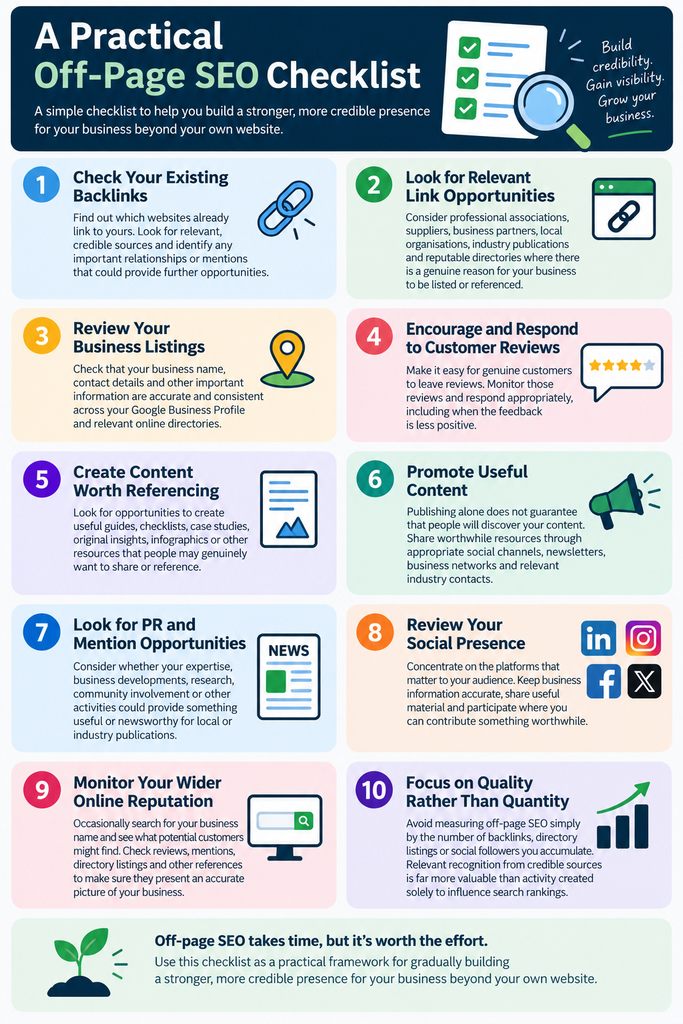
A Practical Off-Page SEO Checklist
Off-page SEO develops over time, so you do not need to tackle everything at once. Use this checklist to review your current presence and identify areas where there may be worthwhile opportunities.
1. Check Your Existing Backlinks
Find out which websites already link to yours. Look for relevant, credible sources and identify any important relationships or mentions that could provide further opportunities.
2. Look for Relevant Link Opportunities
Consider professional associations, suppliers, business partners, local organisations, industry publications and reputable directories where there is a genuine reason for your business to be listed or referenced.
3. Review Your Business Listings
Check that your business name, contact details and other important information are accurate and consistent across your Google Business Profile and relevant online directories.
4. Encourage and Respond to Customer Reviews
Make it easy for genuine customers to leave reviews. Monitor those reviews and respond appropriately, including when the feedback is less positive.
5. Create Content Worth Referencing
Look for opportunities to create useful guides, checklists, case studies, original insights, infographics or other resources that people may genuinely want to share or reference.
6. Promote Useful Content
Publishing alone does not guarantee that people will discover your content. Share worthwhile resources through appropriate social channels, newsletters, business networks and relevant industry contacts.
7. Look for PR and Mention Opportunities
Consider whether your expertise, business developments, research, community involvement or other activities could provide something useful or newsworthy for local or industry publications.
8. Review Your Social Presence
Concentrate on the platforms that matter to your audience. Keep business information accurate, share useful material and participate where you can contribute something worthwhile.
9. Monitor Your Wider Online Reputation
Occasionally search for your business name and see what potential customers might find. Check reviews, mentions, directory listings and other references to make sure they present an accurate picture of your business.
10. Focus on Quality Rather Than Quantity
Avoid measuring off-page SEO simply by the number of backlinks, directory listings or social followers you accumulate. Relevant recognition from credible sources is far more valuable than activity created solely to influence search rankings.
This checklist is not a set of tasks that needs to be completed every month. Use it as a practical framework for gradually building a stronger, more credible presence for your business beyond your own website.
Off-Page SEO Takes Time
Unlike changing a page title or improving the content on your website, many off-page SEO activities cannot produce immediate results. Building relationships, earning links, attracting reviews and developing a stronger online reputation all take time.
This is one reason why off-page SEO should be approached as an ongoing part of your digital activity rather than a short-term campaign. A handful of relevant links, genuine reviews and credible mentions accumulated steadily can be more valuable than a sudden burst of activity designed simply to influence search rankings.
It is also important to be realistic about what you can control. You can create useful content, build relationships, provide good customer service and make your business visible in the right places, but you cannot force other websites to link to you or customers to recommend you.
Concentrate instead on creating the conditions that make those things more likely to happen. Keep your business information accurate, maintain relationships with relevant organisations, encourage genuine reviews and continue producing material that is worth discovering and sharing.
Off-page SEO is ultimately about building reputation and authority. Those are earned gradually, but the benefits can extend well beyond search visibility by helping more people discover, recognise and trust your business.
Conclusion
Off-page SEO is about much more than building backlinks. It is about developing the authority, reputation and visibility of your business across the wider web.
Relevant links and mentions, customer reviews, business citations, digital PR, social activity and useful content can all contribute to a stronger online presence. Individually, these activities may seem relatively small, but together they help create a broader picture of a credible and established business.
For small businesses, the most effective approach is usually to concentrate on relevance and quality rather than volume. Build genuine relationships, maintain accurate business information, encourage authentic reviews and create resources that other people have a reason to reference or share.
There are no shortcuts to building genuine authority. But by steadily strengthening your presence beyond your own website, you can support your search visibility while also helping more potential customers discover, recognise and trust your business.
Want to Strengthen Your Online Authority?
Building authority beyond your website takes time, but you do not need to tackle every aspect of off-page SEO at once.
Start by reviewing where your business already appears online. Look at the websites linking to you, your business listings and reviews, your social presence and any mentions of your business elsewhere. From there, you can identify practical opportunities to strengthen your reputation and visibility.
The checklist in this guide provides a useful starting point. Choose the areas most relevant to your business and work on them gradually rather than trying to generate large numbers of links or listings simply for the sake of SEO.
For more practical guidance on improving your search visibility, explore our other Digital Strategy articles covering on-page SEO, Google Business Profile and E-E-A-T.
You can also subscribe to the Digital Strategy newsletter for future articles, guides, checklists and practical advice to help strengthen your business’s online presence.