
The Four Pillars of E-E-A-T: Building Trust and Authority Online

Introduction
When people discover your business online, how do they decide whether they can trust what they find?
They may look at your website, read customer reviews, examine your Google Business Profile, browse your articles or look for evidence of your experience. Before making contact, they are already forming an opinion about whether your business appears genuine, knowledgeable and credible.
Google considers many of these same qualities when assessing the quality and usefulness of online content. One framework used within Google’s Search Quality Rater Guidelines is E-E-A-T: Experience, Expertise, Authoritativeness and Trust.
The terminology may sound technical, but the principles behind it are remarkably straightforward. Have you actually experienced or done what you’re writing about? Do you have appropriate knowledge of the subject? Is there evidence that others recognise your business or expertise? And, perhaps most importantly, can people trust you and the information you provide?
For small businesses, E-E-A-T isn’t about trying to satisfy an SEO checklist or achieve an imaginary score. It is about demonstrating the qualities that help both customers and search engines understand who you are, what you know and why the information you publish is worth paying attention to.
In this article, we’ll look at each of the four elements of E-E-A-T and, more importantly, explore practical ways your business can demonstrate them through its website and wider online presence.
What Is E-E-A-T?
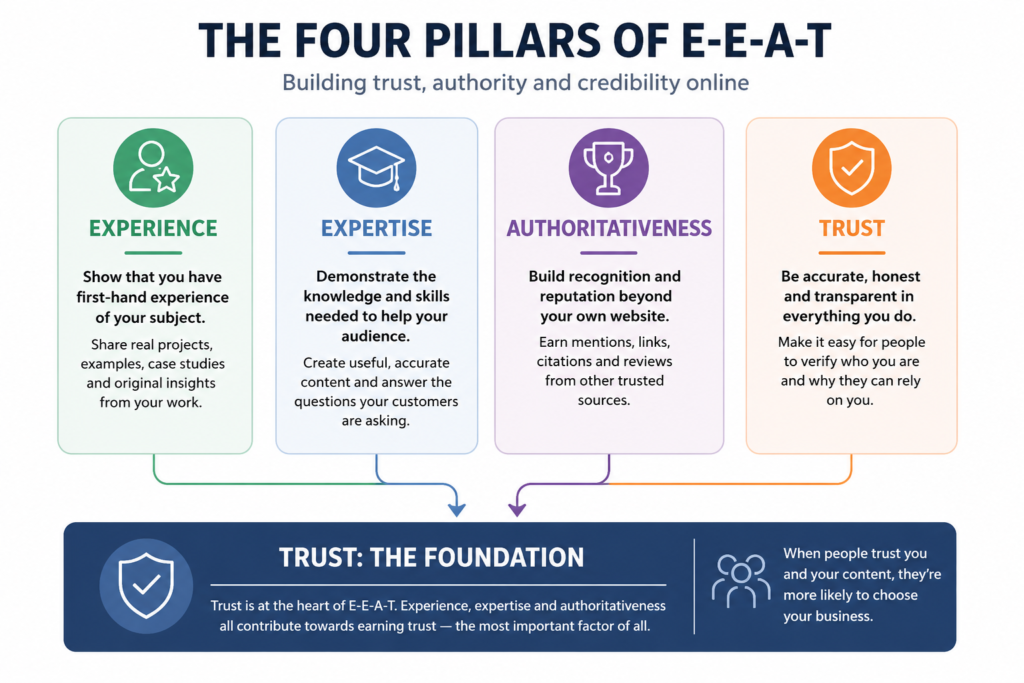
E-E-A-T stands for Experience, Expertise, Authoritativeness and Trust. It is a framework used within Google’s Search Quality Rater Guidelines to help assess the quality and credibility of content and the people or organisations responsible for it.
Experience refers to whether the person creating the content has genuine first-hand experience of the subject. Expertise considers whether they have the knowledge or skills needed to provide useful and accurate information. Authoritativeness is about reputation and whether the person, business or website is recognised as a reliable source. Trust considers whether the content and the organisation behind it are accurate, honest, transparent and dependable.
It is important to understand that E-E-A-T isn’t a score that Google assigns to your website, nor is it a single ranking factor that can simply be optimised. Instead, it provides a useful way of thinking about the signals that help demonstrate the quality and credibility of online information.
Trust sits at the centre of the concept. Experience, expertise and authority can all contribute towards establishing trust, but ultimately people need confidence in both the information they are reading and the business or individual providing it.
For a small business, this makes E-E-A-T surprisingly practical. It means showing real experience, demonstrating genuine knowledge, building a positive reputation and making it easy for customers to understand who is behind the business.
These aren’t qualities that can be manufactured with a few SEO techniques. They are qualities a genuine business develops over time — and its website and wider online presence should provide clear evidence of them.
Experience: Show That You’ve Actually Done It
The first E in E-E-A-T is Experience. It considers whether the person creating content has genuine first-hand experience of the subject they are discussing.
For a small business, this can be one of the easiest qualities to demonstrate because your everyday work already provides the evidence. A builder can show completed projects, a restaurant can share photographs of its food and premises, a consultant can discuss situations they have worked on, and a retailer can demonstrate genuine knowledge of the products they sell.
Your website provides plenty of opportunities to show this experience. Case studies, project examples, original photographs, customer stories and articles based on problems you have actually encountered can all demonstrate that your knowledge comes from practical involvement rather than simply repeating information available elsewhere.
This is particularly valuable when creating articles and advice. Instead of producing generic content that could have been written by almost anyone, include observations, examples and lessons learned through your own work. Explain what happened, what you discovered and how you approached a particular problem.
Experience doesn’t mean that every page needs to become a detailed case study. Often, relatively small details can demonstrate that the person writing understands the subject from practical involvement.
The objective is simple: wherever appropriate, show rather than merely claim your experience. Real examples, genuine photographs and useful insights from work you have actually undertaken provide much stronger evidence than simply telling visitors that your business has years of experience.
Expertise: Demonstrate What You Know
While experience shows that you have actually worked with a subject, expertise demonstrates that you understand it. It is the knowledge and skill behind the advice, products or services your business provides.
For small businesses, expertise can come from many sources. It might have developed through professional qualifications and formal training, but equally it may come from years of practical work, specialist knowledge or solving the same kinds of problems for customers repeatedly.
Your website gives you an opportunity to demonstrate that expertise rather than simply claim it. Publishing useful articles that answer genuine customer questions, explaining complicated subjects clearly and providing practical advice can all show potential customers that you understand your field.
The quality of that content matters more than simply producing large quantities of it. An article that provides a useful answer based on genuine knowledge is far more valuable than several generic articles created simply to target search terms. Where appropriate, explain why you recommend a particular approach, provide examples and acknowledge situations where there may be more than one solution.
It should also be clear who is providing the information. Author biographies, About pages, professional backgrounds and relevant qualifications can help visitors understand why they should pay attention to your advice.
You don’t need to describe yourself as an expert at every opportunity. In fact, demonstrating knowledge is usually more convincing than claiming expertise. Provide useful information, answer questions accurately and allow the quality of your content and your work to demonstrate what you know.
Authoritativeness: Build Recognition Beyond Your Own Website
Expertise is what you know. Authoritativeness is partly about whether other people recognise your knowledge, experience or reputation.
It is relatively easy for any business to describe itself as experienced, knowledgeable or successful on its own website. Those claims become much more convincing when there is supporting evidence elsewhere online.
For a small business, that evidence can take many forms. Customer reviews, recommendations, links from other reputable websites, mentions in local or industry publications, professional memberships, directory listings and references from organisations you have worked with can all contribute to your wider reputation.
Authority can also develop through the content you publish. If an article genuinely helps people understand a subject, others may share it, refer to it or link to it as a useful resource. Over time, a collection of well-researched and genuinely helpful content can establish your website as a useful source of information within your particular field.
Consistency is important too. Your business name, services, contact information and professional profiles should present a coherent picture across your website, Google Business Profile, social networks and other reputable online sources. This makes it easier for both people and search engines to understand who you are and what your business does.
Building authority takes time. It isn’t something that can be manufactured simply by creating more pages or making stronger claims about your expertise.
Instead, concentrate on doing good work, publishing useful information and building genuine relationships and recognition within your industry and community. Authority develops when your reputation begins to extend beyond what you say about yourself on your own website.
Trust: The Foundation of E-E-A-T
Trust is the most important element of E-E-A-T. Experience, expertise and authority can all help establish credibility, but ultimately visitors need to feel confident that your business and the information you provide can be relied upon.
For a small business, trust often begins with relatively simple things. Your website should make it clear who you are, what your business does and how people can contact you. Business information should be accurate and consistent, while claims about your products, services or experience should be honest and capable of being supported.
Transparency also matters. An informative About page, clear contact details, appropriate author information and straightforward explanations of your services all help visitors understand who is behind the website. Where your business handles payments or personal information, secure systems and clear privacy information provide further reassurance.
Customer reviews can provide particularly valuable evidence of trust because they reflect experiences outside your own organisation. Responding professionally to both positive and negative feedback also demonstrates that there are real people behind the business who take their customers seriously.
Trust extends to the content you publish. Information should be accurate, useful and kept up to date. If you make factual claims, use reliable sources where appropriate. If something is based on your own experience or opinion, make that clear rather than presenting it as an established fact.
Ultimately, trust isn’t created by adding a badge or writing that your business is trustworthy. It develops from the combined impression created by everything someone encounters online.
When your experience, expertise, reputation, content and business information all tell a consistent and credible story, you give potential customers good reasons to trust you.
How Small Businesses Can Improve Their E-E-A-T
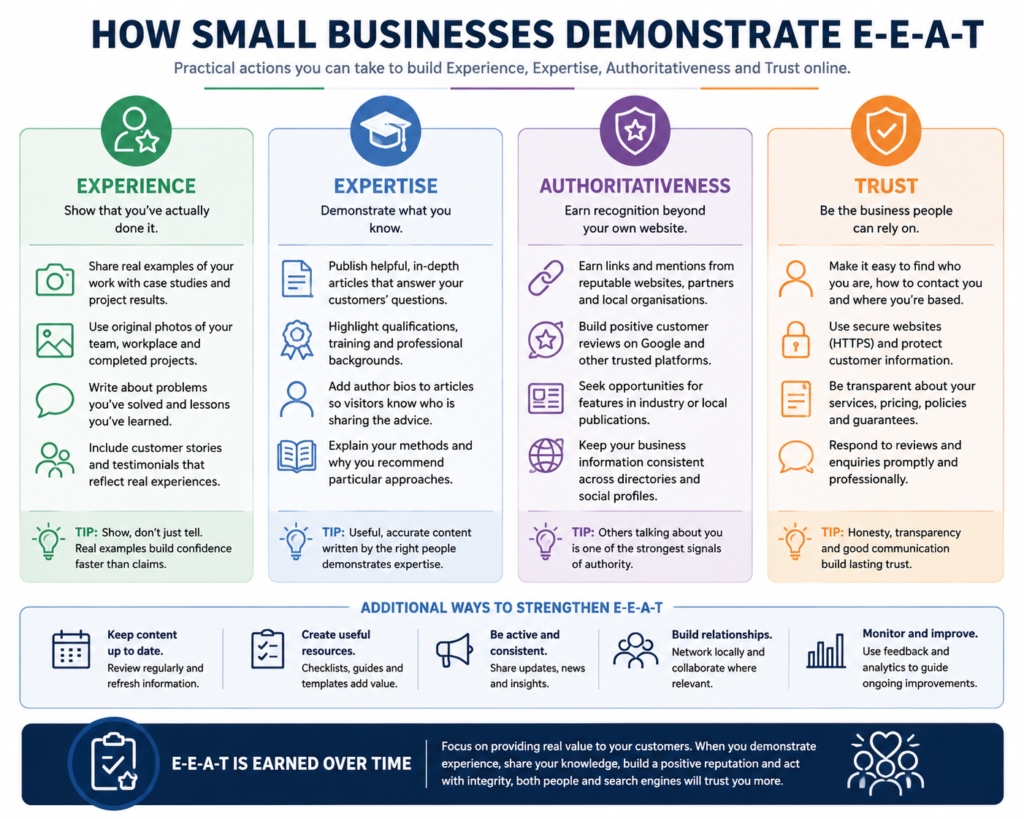
Improving E-E-A-T doesn’t require a complicated SEO project. In many cases, it is about making better use of the experience, knowledge and reputation your business already has and ensuring that these qualities are visible online.
Start by reviewing your website from a potential customer’s point of view. Is it obvious who is behind the business? Does your About page explain your background and experience? Are your contact details easy to find? If you publish advice or articles, can visitors see who wrote them and why that person is qualified to discuss the subject?
Look for opportunities to demonstrate real experience. Add case studies, examples of completed work, original photographs or practical observations from projects you have undertaken. If customers regularly ask the same questions, use your knowledge to create useful content that answers them properly.
Your wider online presence deserves attention too. Keep your Google Business Profile and reputable business listings accurate, encourage genuine customer reviews and respond to them. Maintain appropriate professional profiles and look for legitimate opportunities to earn mentions or links from relevant organisations, publications and industry sources.
Existing content should also be reviewed periodically. Advice can become outdated, businesses change and information that was accurate several years ago may no longer be useful. Updating older content can be just as valuable as continually publishing something new.
Most importantly, don’t approach E-E-A-T as a collection of tricks designed to impress Google. Concentrate on providing clear evidence of a genuine business run by people with real knowledge and experience.
If potential customers can easily understand who you are, see evidence of what you have done, recognise that you know your subject and find independent reasons to trust you, you are already putting the principles of E-E-A-T into practice.
E-E-A-T, SEO and AI Search
E-E-A-T is closely associated with SEO, but it is important not to think of it as another optimisation technique. There isn’t an E-E-A-T score to improve or a set of keywords that can suddenly make a website appear more trustworthy.
Instead, the principles behind E-E-A-T support something much broader: creating useful content from identifiable and credible sources. That fits naturally with good SEO. Search engines want to provide people with information that is relevant, reliable and genuinely helpful, while businesses want potential customers to find information that gives them confidence to take the next step.
These principles are becoming increasingly relevant as the way people search for information changes. Traditional search results are now joined by AI-generated answers and conversational search tools that can summarise information from multiple sources rather than simply presenting a list of websites.
This has led to growing interest in terms such as Generative Engine Optimisation (GEO), but the underlying objective remains familiar. Businesses need to publish clear, useful and trustworthy information that can be understood, associated with the right organisation or individual, and supported by evidence elsewhere online.
E-E-A-T therefore provides a useful bridge between traditional SEO and this developing world of AI-assisted search. Genuine experience, demonstrated expertise, recognised authority and strong trust signals are valuable whether someone discovers your business through Google Search, an AI-generated answer or another digital channel.
The technology used to find information will continue to change. Building a credible online presence based on real experience, useful knowledge and trust is a much more durable strategy than trying to optimise for every new search technology as it appears.
Conclusion
E-E-A-T may have originated as terminology within Google’s Search Quality Rater Guidelines, but the principles behind it extend far beyond search engines.
Experience, expertise, authoritativeness and trust are ultimately about demonstrating that there are real, knowledgeable people behind your business and giving potential customers good reasons to believe what you say.
For most small businesses, much of that evidence already exists. You have completed projects, solved customer problems, developed specialist knowledge and built a reputation through the work you do. The challenge is making sure that your website and wider online presence communicate those qualities clearly.
That means showing genuine examples of your work, publishing useful content based on what you know, keeping business information accurate, encouraging customer reviews and building recognition beyond your own website.
None of this happens overnight, and there is no shortcut to genuine credibility. E-E-A-T is something that develops as your experience, content and reputation grow.
Rather than trying to optimise your website for E-E-A-T, concentrate on demonstrating the qualities behind it. Build an online presence that accurately reflects your experience, knowledge and reputation, and both potential customers and search engines will have stronger reasons to trust your business.
Build a Stronger, More Credible Online Presence
E-E-A-T isn’t about ticking boxes. It’s about making sure your online presence reflects the genuine experience, knowledge and reputation behind your business.
For more practical advice on SEO, websites, online visibility and digital strategy, explore our latest articles or subscribe to the Digital Strategy newsletter for future articles, checklists and downloadable resources.
If you’d like practical help reviewing your website and strengthening your business’s online presence, Digital Direction provides independent digital consultancy to help small businesses identify what can be improved and where to focus next.