E-commerce: Selling Products and Services Online

Introduction
E-commerce has transformed the way businesses sell to their customers. What was once primarily the domain of large retailers is now accessible to businesses of almost every size.
For small and medium-sized businesses, e-commerce can provide new ways to reach customers, generate revenue and extend a business beyond its physical location.
But successful e-commerce involves more than adding products to a website and accepting payments. The complete customer journey—from discovering a product to receiving it and potentially buying again—needs to work effectively.
What Is E-commerce?
E-commerce is the buying and selling of products or services through digital channels.
For many people, this means an online shop selling physical products, but e-commerce can take many different forms. Businesses can sell:
- physical products
- digital downloads
- subscriptions
- courses and training
- tickets and bookings
- professional services
- products through online marketplaces
E-commerce does not necessarily mean replacing an existing way of doing business. For many small and medium-sized businesses, it provides an additional way for customers to buy, book or pay.
A retailer might sell through both a physical shop and a website. A service business might allow customers to book and pay online. A manufacturer or wholesaler might provide existing customers with an online ordering facility. Other businesses may operate entirely online.
Whatever the model, successful e-commerce involves much more than providing a way to take payment.
Customers need to be able to find what they are looking for, understand what is being offered, compare their options, trust the business and complete the purchase without unnecessary difficulty. What happens after the transaction, including confirmation, delivery, support and returns, also contributes to the overall experience.
The technology is important, but it should support the way customers want to buy and the way the business needs to operate, rather than determining the experience itself.
Start With the Customer
Successful e-commerce starts with understanding the customer rather than choosing the technology.
Before deciding which platform to use or what features an online shop should include, consider how customers actually buy from your business.
How will they discover your products or services? What information will they need before making a decision? Will they want to compare different options? What questions or concerns might prevent them from buying? What needs to happen before they feel confident enough to complete the purchase?
The customer journey might begin with a search engine, social media post, recommendation, advertisement or previous experience with the business. Once someone reaches the website, they need to be able to find the right product or service quickly and understand whether it meets their needs.
As they move closer to purchasing, different questions become important. They may want to know about price, availability, delivery, payment options, returns, guarantees or what happens after they place an order.
The purchasing process itself should be as straightforward as possible. Unnecessary steps, confusing forms, unexpected costs or uncertainty about what happens next can all cause customers to abandon a purchase.
The journey also continues after payment. Order confirmation, delivery information, fulfilment, customer support and returns all influence how customers feel about the experience and whether they are likely to buy again.
Understanding this complete journey helps identify what the e-commerce experience actually needs to provide.
Technology should then be selected and configured to support that journey, rather than forcing customers to adapt to the limitations of the
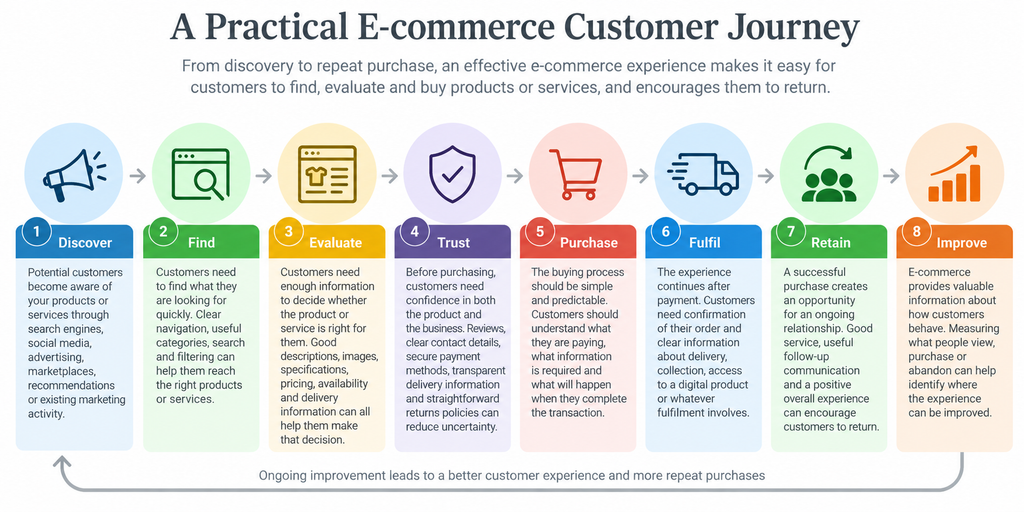
A Practical E-commerce Customer Journey
An effective e-commerce experience should make it easy for customers to move from discovering a product or service to completing a purchase and, ideally, becoming a repeat customer.
For a small or medium-sized business, the journey can be thought of as eight practical stages:
Discover
Potential customers first need to become aware of your products or services. They might find you through search engines, social media, advertising, marketplaces, recommendations or existing marketing activity.
Find
Once they arrive, customers need to find what they are looking for quickly. Clear navigation, useful categories, search and filtering can all help them reach the right products or services.
Evaluate
Customers need enough information to decide whether the product or service is right for them. Good descriptions, images, specifications, pricing, availability and delivery information can all help them make that decision.
Trust
Before purchasing, customers need confidence in both the product and the business. Reviews, clear contact details, secure payment methods, transparent delivery information and straightforward returns policies can reduce uncertainty.
Purchase
The buying process should be simple and predictable. Customers should understand what they are paying, what information is required and what will happen when they complete the transaction.
Fulfil
The experience continues after payment. Customers need confirmation of their order and clear information about delivery, collection, access to a digital product or whatever fulfilment involves.
Retain
A successful purchase creates an opportunity for an ongoing relationship. Good service, useful follow-up communication and a positive overall experience can encourage customers to return.
Improve
E-commerce provides valuable information about how customers behave. Measuring what people view, purchase or abandon can help identify where the experience can be improved.
These stages do not always happen in a simple sequence. Customers may compare products, leave the website, return later or use several different channels before making a purchase. The objective is to make each part of that journey as clear, convenient and trustworthy as possible.
Make Products Easy to Find and Understand
Customers cannot examine an online product in the same way they can in a physical shop. Your website therefore needs to provide the information and reassurance they need to make a confident buying decision.
That starts with making products easy to find.
Clear navigation and sensible product categories help customers understand what is available and move quickly towards the products that interest them. For larger ranges, search and filtering can become particularly important. Customers may want to narrow their choices by product type, size, price, colour, availability or other characteristics relevant to what you sell.
The way products are organised should reflect how customers think about them, rather than simply mirroring the internal structure of the business.
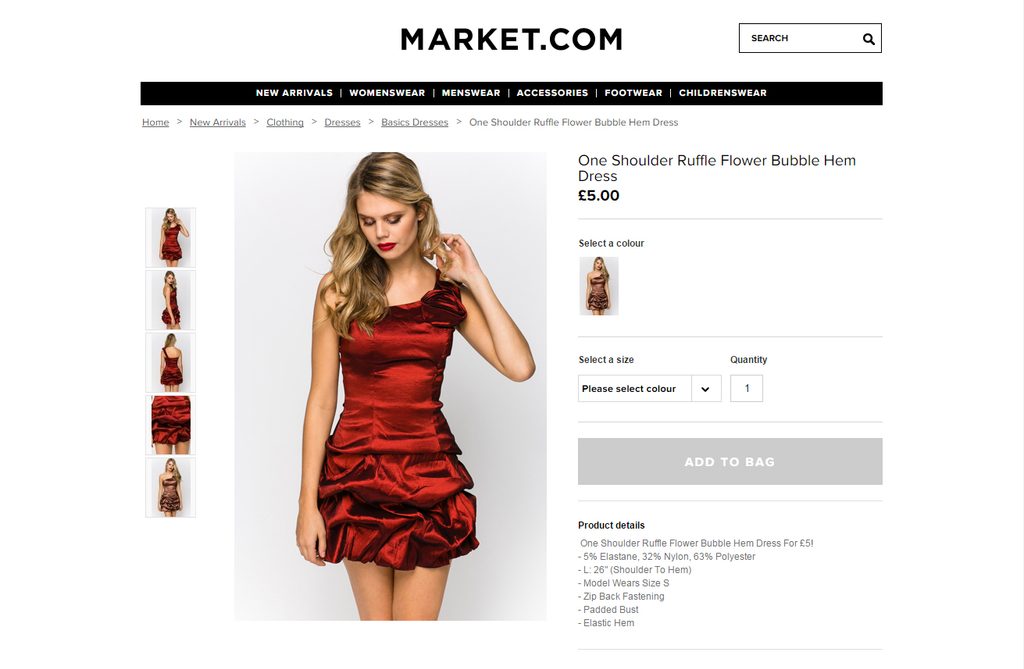
Once a customer reaches a product page, it needs to answer the questions they are likely to have. Depending on the product, this might include:
- a clear and useful product description
- good quality images showing the product appropriately
- price and any available options
- sizes, dimensions or specifications
- stock or availability information
- delivery costs and timescales
- returns or refund information
- answers to common questions
The amount of information required will vary. A relatively simple, low-cost product may need very little explanation, while a more expensive or complicated purchase may require detailed specifications, several images, supporting information or comparison with other options.
Product and category pages also have an important role in attracting potential customers. Search engines need to understand what you sell just as customers do. Clear page titles, useful descriptions, logical categories and relevant product information can help individual products and categories appear when people search for them.
The objective is not to overwhelm customers with information. It is to make the right information easy to find at the point when they need it.
A customer who can quickly find a relevant product, understand what is being offered and have their important questions answered has fewer reasons to leave without buying.

Build Trust Into the Buying Process
Trust is particularly important in e-commerce. Before customers provide personal information or payment details, they need to feel confident that the business is genuine, the transaction is secure, and they understand exactly what they are buying.
Trust is built throughout the customer journey rather than at the checkout alone.
A professional and consistent website is a good starting point. Clear contact information, information about the business and straightforward ways to ask questions all help demonstrate that there is a genuine organisation behind the website.
Customers also need confidence in the product or service itself. Reviews, ratings, testimonials and other appropriate evidence can help reduce uncertainty, particularly when someone is buying from a business for the first time.
Delivery and returns information should be easy to find before a customer reaches the checkout. Customers may want to know how much delivery will cost, how long it will take, what happens if they are unavailable and how they can return something if it is unsuitable.
The same principle applies to pricing. Unexpected delivery charges, taxes, additional fees or other costs introduced late in the checkout process can quickly undermine confidence and cause customers to abandon a purchase.
Payment should feel secure and familiar. Customers should understand which payment methods are available and be given clear confirmation when a transaction has been completed. The website should not ask for information that is unnecessary for completing the order.
The checkout itself should also be kept as straightforward as possible. Every additional page, form field or decision introduces another opportunity for the customer to stop. Where additional information is genuinely required, explain why and make the process easy to understand.
Trust does not come from displaying a few security symbols at the final stage of an order. It comes from creating a buying experience that is clear, consistent and predictable from the moment a customer arrives until the purchase is complete.
Choosing E-commerce Technology
There is no single e-commerce platform or technology that is right for every business.
A small business selling a limited range of products may need little more than a straightforward online shop with secure payments and simple delivery options. A larger or more complex operation may need stock management, multiple delivery methods, accounting integration, customer accounts, subscriptions, marketplace connections or links with existing business systems.
The starting point should therefore be what the business and its customers actually need, rather than choosing a platform first and then adapting the business around it.
Consider how products will be managed, how orders will be processed, how payments will be handled and what needs to happen once an order has been placed. If stock is also sold through a physical shop, marketplace or other channel, you may need to consider how inventory is kept accurate across them.
Integration with other systems can also become important. An e-commerce platform may need to exchange information with accounting software, stock control, delivery services, customer management systems or other parts of the business.
It is worth considering future requirements, but that does not mean building a complicated system in anticipation of every possible need. Unnecessary features and integrations can increase cost, maintenance and administration without improving the customer experience.
Equally, choosing purely on the basis of the lowest initial cost can create problems if the system quickly becomes restrictive as the business develops.
The most appropriate technology is therefore not necessarily the platform with the most features. It is the one that supports the customer journey, works effectively with the way the business operates and provides enough flexibility for realistic future requirements.
What Happens After the Sale Matters Too
The customer journey does not end when someone completes the checkout.
What happens next can have a significant effect on how customers feel about the purchase, whether they recommend the business and whether they choose to buy from you again.
The first step is clear confirmation. Customers should know that their order has been received, what they have purchased, how much they have paid and what will happen next. If a physical product is being delivered, they should also understand when they can expect it and how they will be kept informed.
Fulfilment then needs to match the expectations created during the buying process. Products should be dispatched when promised, digital products should be accessible as expected, and bookings or services should be confirmed clearly.
When something goes wrong, good communication becomes even more important. Delays, unavailable products or delivery problems may sometimes be unavoidable, but keeping the customer informed and explaining what will happen next can prevent a problem becoming a poor overall experience.
Returns and refunds are also part of the e-commerce journey. The process should be easy to understand and customers should know how to get help when they need it. Making returns unnecessarily difficult may discourage not only that customer from buying again, but other potential customers who see their experience through reviews or recommendations.
A successful order also creates an opportunity to develop the customer relationship. Appropriate follow-up communication, useful information about the product, good customer service and a consistently positive experience can all encourage repeat business.
This does not mean bombarding customers with promotional messages as soon as they have purchased. The priority should be completing the original transaction well and giving customers a reason to trust the business again.
For many businesses, retaining a satisfied customer can be just as important as attracting a new one. E-commerce should therefore be designed around the complete relationship, not simply the moment when payment is taken.
Measure and Improve
One of the advantages of e-commerce is that much of the customer journey can be measured.
It is possible to see how customers arrive at the website, which products they view, how they move through the site and whether those visits eventually result in a purchase. This can help identify both what is working well and where potential customers are being lost.
Useful measures might include:
- conversion rate
- average order value
- best and worst performing products
- traffic sources that generate sales
- product and category page performance
- abandoned baskets or checkouts
- new and returning customers
- repeat purchases
The important point is not simply to collect more data. Measurement should help answer useful business questions.
If a product receives plenty of visits but very few sales, there may be a problem with the price, description, imagery, availability or delivery options. If customers regularly add products to their basket but leave during checkout, the problem may be unexpected costs, unnecessary complexity or a lack of confidence in the process.
Looking at where customers come from can also help determine which marketing activity is producing worthwhile results. A channel that generates large numbers of visitors is not necessarily valuable if those visitors rarely become customers.
Average order value and repeat purchasing can provide a different perspective. Improving e-commerce performance does not always mean attracting more visitors. Helping existing customers find complementary products, improving their experience or encouraging them to return can also increase revenue.
Changes should be based on evidence where possible. Small improvements to navigation, product information, delivery choices, checkout or customer communication can sometimes have a significant effect when applied across many transactions.
E-commerce improvement should therefore be an ongoing process. Measure what customers are doing, identify where the journey could work better, make a practical change and then assess whether it has improved the result.
E-commerce as Part of Your Digital Strategy
An online shop should not operate in isolation.
Customers may discover your products through search engines, social media, online marketplaces, email, advertising or other content. Your website then needs to turn that interest into a clear and straightforward route towards a purchase.
Other parts of your digital activity support that journey. SEO can help products and categories appear in relevant searches. Content can answer questions and help customers make decisions. Social media can introduce products to new audiences and maintain relationships with existing customers. Email can support communication before and after a purchase.
Analytics provides another connection. Understanding where customers come from, what they look at, what they buy and where they leave the purchasing process can help improve both your e-commerce operation and the marketing activity that brings people to it.
The experience also extends beyond marketing and the website. Stock management, fulfilment, delivery, customer service and returns all affect whether the promise made online is actually delivered.
For this reason, e-commerce should be considered as part of the wider digital strategy and the way the business operates as a whole.
For a small or medium-sized business, the objective is not simply to put products or services online. It is to create a clear, trustworthy and convenient route from discovering what you offer through to purchasing it, receiving it and, ideally, becoming a satisfied returning customer.
Want to Improve Your E-commerce Experience?
Successful e-commerce is about more than putting products or services online. The complete customer journey needs to work, from helping people find what they need through to purchasing, fulfilment and encouraging them to return.
If you already sell online, or are considering introducing e-commerce to your business, an independent review can help identify opportunities to improve the customer experience, remove unnecessary barriers and make sure your technology supports what you are trying to achieve.
Need help with your e-commerce or wider digital strategy?
Get in touch to discuss your business, your customers and where improvements could make the greatest difference.