
Social Media: Building a Useful Presence for Your Business

Introduction
Social media has become an established part of the digital landscape. Platforms such as Facebook, Instagram, LinkedIn, YouTube and others provide businesses with opportunities to communicate directly with customers, demonstrate expertise and increase awareness.
But simply creating accounts and posting occasionally is not a social media strategy.
For small and medium-sized businesses, the challenge is deciding which platforms are relevant, what to communicate and how social media can support wider business objectives without consuming an unreasonable amount of time.
What Is Social Media Strategy?
A social media strategy defines how a business will use social platforms to achieve specific objectives.
Those objectives might include increasing awareness, attracting visitors to the website, generating enquiries, developing relationships with potential customers, supporting existing customers or promoting particular products and services.
A useful strategy starts with the people the business wants to reach. Understanding who they are, which social platforms they use and what information is likely to interest or help them makes it easier to decide where to concentrate your efforts.
It should also consider what types of content the business will publish and what purpose that content serves. Some posts might provide useful advice or answer common questions. Others might demonstrate expertise, share examples of work, promote useful website content or introduce a product or service.
The strategy does not need to be complicated. For a small business, it might simply define the audience you want to reach, the platforms you will concentrate on, the subjects you will talk about, how regularly you will publish and what you want people to do as a result.
It should also establish how success will be measured. The measures that matter depend on the objective. Website visits, enquiries, conversations or sales may provide a much better indication of value than simply counting followers or likes.
This turns social media from an isolated activity into a purposeful part of the wider digital strategy.
Choose the Right Social Media Platforms
Businesses do not need to be active everywhere.
Different social platforms attract different audiences and encourage different types of interaction. A platform that works extremely well for one organisation may provide very little value for another.
The starting point should be your audience. Where are the people you want to reach already spending their time, and how are they using those platforms? A business selling visually appealing consumer products may have very different requirements from a consultancy selling professional services to other businesses.
You should also consider what you want social media to achieve. Some platforms may be useful for building professional relationships and demonstrating expertise, while others may be better suited to visual content, local awareness, customer interaction or reaching particular consumer audiences.
The type of content you can realistically produce matters too. There is little value in choosing a platform that depends heavily on regular video or visual content if you do not have the time or resources to produce it consistently.
For a small business, available time is particularly important. Maintaining several accounts with little activity can be less effective than concentrating on one or two platforms and using them properly.
Review what is already working as well. If one platform consistently generates conversations, website visits, enquiries or other useful activity, that is a good reason to give it greater attention. Equally, a platform that consumes considerable time without producing meaningful results may not deserve continued investment.
The important question is therefore not, “Which social networks should we be using?” but, “Where can we most effectively reach the people who matter to our business?”
Choose the platforms that best match your audience, objectives, content and available resources, and concentrate on using them consistently and well
A Simple Social Media Strategy for a Small Business
A social media strategy does not need to involve complicated plans, large budgets or constant posting. For most small businesses, the aim should be to establish a manageable approach that supports clear business objectives.
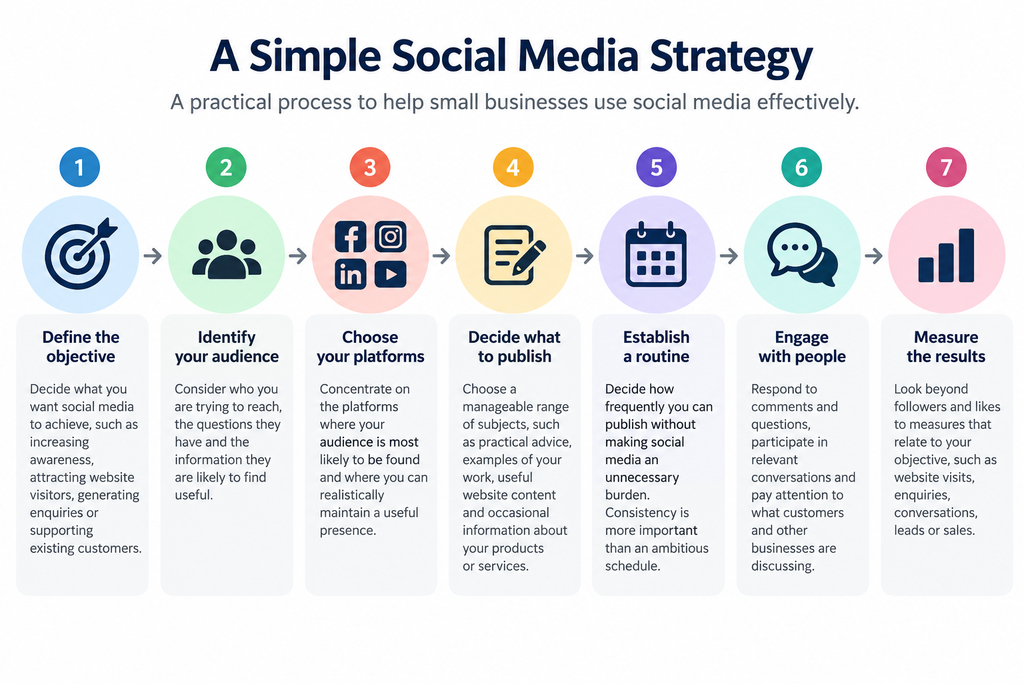
A simple process can help keep your social media activity focused.
Define the objective
Start by deciding what you want social media to achieve. You might want to increase awareness, attract more people to your website, generate enquiries, promote particular services, develop professional relationships or communicate with existing customers.
Identify your audience
Consider who you are trying to reach. Think about the customers or potential customers who matter to your business, the questions they have and the information they are likely to find useful.
Choose your platforms
Concentrate on the platforms where your audience is most likely to be found and where you can realistically maintain a useful presence. For many small businesses, using one or two platforms consistently will be more effective than trying to be active everywhere.
Decide what to publish
Choose a manageable range of subjects that reflect your expertise and are relevant to your audience. This might include practical advice, answers to common questions, examples of your work, industry observations, useful website content and occasional information about your products or services.
Establish a realistic routine
Decide how frequently you can publish without making social media an unnecessary burden. Consistency is more important than attempting an ambitious schedule that cannot be maintained.
Engage with people
Social media is not simply a publishing channel. Respond to comments and questions, participate in relevant conversations and pay attention to what customers and other businesses are discussing.
Measure the results
Review what is happening as a result of your activity. Look beyond followers and likes to measures that relate to your original objective, such as website visits, enquiries, conversations, leads or sales.
The aim is to create a repeatable process that the business can realistically maintain. As you learn which platforms, subjects and types of content produce useful results, the strategy can be adjusted and improved.
Create Content That Has a Purpose
Social media content should give people a reason to pay attention.
That does not mean every post needs to sell something. In fact, constantly publishing promotional messages can make an account considerably less useful. A better approach is to create a mixture of content that informs, helps, demonstrates expertise and occasionally promotes what the business offers.
Practical advice and answers to common questions can be particularly useful. Think about the questions customers regularly ask, the problems they encounter and the information that would help them make better decisions. These subjects can provide a steady source of relevant content.
Social media can also demonstrate what your business knows and does. You might share examples of completed work, customer success stories, useful observations from your industry or insights gained through your own experience. This can help potential customers understand your expertise before they ever contact you.
Existing website content can provide another valuable source of material. An article or guide might generate several individual social posts, each concentrating on a different point and directing interested readers back to the original content. Videos, infographics, checklists and other useful resources can also be introduced to a wider audience through social media.
Some content should, of course, promote your products and services. The important point is balance. Promotional posts are more likely to be effective when they appear alongside genuinely useful content rather than forming the entire social media presence.
It can help to think of your content as a simple mixture: useful information, answers and advice; evidence of your knowledge and experience; conversations and engagement; and appropriate promotion of your products or services.
The objective is not simply to fill a publishing schedule. Every post should have a reason for being there and contribute in some way to what the business is trying to achieve.
Social Media Should Lead Somewhere
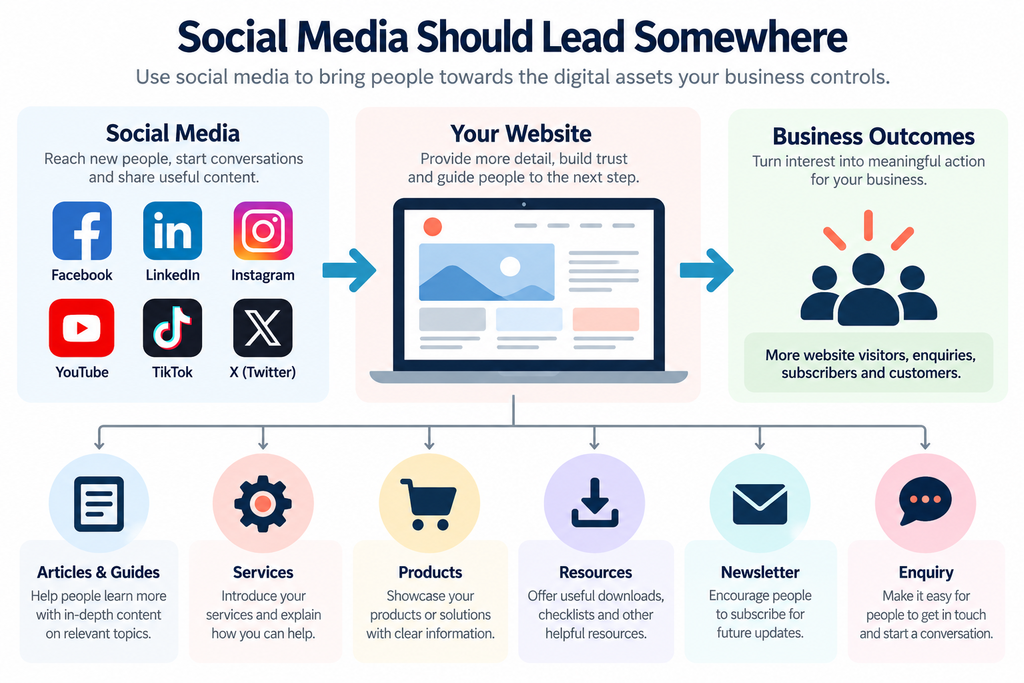
Social media platforms can help businesses reach people, start conversations and introduce useful information, but they should not necessarily become the final destination.
Where appropriate, social activity should encourage people to continue their journey through digital resources that the business controls.
A social post might introduce an idea and then direct someone towards a more detailed article or guide on your website. A post about a product could lead to an e-commerce page. A professional insight might encourage someone to visit a service page, explore related information or learn more about the business.
The next step does not always have to be a sale. Someone might subscribe to a newsletter, download a useful resource, read another article or simply spend more time understanding what your business can offer.
This relationship between social media and the organisation’s own website is important. Social platforms provide access to audiences, but businesses do not control those platforms, their algorithms or how many followers will see a particular post.
Your website, email list and other digital assets that you control provide a more permanent foundation. Social media can help attract people to those resources and provide additional opportunities to develop the relationship.
Social media is therefore most useful when it supports the wider digital presence of the business rather than operating as an isolated activity.
Engagement Matters
The word “social” is important.
Social media provides an opportunity for two-way communication. Publishing useful content is only part of the process. Responding to comments, answering questions and participating in relevant conversations can be just as valuable as creating the original post.
For smaller businesses in particular, this can help demonstrate that there are real people behind the organisation. A helpful response to a question or a genuine conversation can create a stronger impression than another promotional message.
Engagement can also extend beyond people who already follow your business. Participating in relevant industry discussions, local business groups or community conversations can introduce your expertise to people who may not otherwise encounter your content. The aim should be to contribute something useful rather than simply use other people’s conversations as an opportunity to promote the business.
Pay attention to the questions people ask and the subjects that generate discussion. These can provide useful insight into what customers are interested in, what they find confusing and the problems they are trying to solve.
That information can influence future social posts, website content, articles and even the way products or services are presented.
Engagement should therefore be treated as more than another social media metric. Used properly, it helps build relationships, increases understanding of your audience and makes social media a genuine communication channel rather than simply somewhere to publish content.
Measure What Is Working
Follower numbers and likes can be encouraging, but they do not necessarily demonstrate that social media is providing value to the business.
The measurements that matter depend on what you originally wanted to achieve.
If the objective is to increase awareness, measures such as reach, impressions and engagement may be useful. If you want to attract people to your website, referral visits and the pages those visitors view become more important.
If the objective is to generate business, look at enquiries, leads, bookings or sales that can be connected to your social media activity. For businesses using social media for customer communication, response times, conversations and the quality of engagement may be more relevant.
It is also useful to compare different types of content. Which subjects generate useful conversations? Which posts encourage people to visit your website? Which formats consistently receive little attention? Are particular platforms producing better results than others?
You do not need to measure everything. Concentrate on a small number of measures that relate directly to your objectives and review them regularly.
Look for patterns over time rather than judging success or failure from an individual post. Social media results can vary considerably, and a post that receives relatively little visible engagement may still result in a useful website visit, enquiry or conversation.
Regularly reviewing the results helps you decide which platforms, subjects and types of content deserve continued attention. You can then do more of what works, change what does not and ensure that the time spent on social media continues to support the wider goals of the business.
Social Media as Part of Your Digital Strategy
Social media works best when it supports the wider digital strategy of the business rather than operating as a separate activity.
The subjects you discuss on social media can connect with the content on your website. Articles and guides can provide useful material to share, while social conversations can reveal questions and interests that could become future website content.
Social media can also support other digital activities. It can increase awareness of your business, introduce people to your products and services, bring visitors to your website and help distribute useful content to a wider audience. It can also reinforce your expertise and provide another way for potential customers to become familiar with your business before making contact.
The important point is that these activities should work together. Someone might first discover your business through a social post, visit your website to read an article, explore a relevant service and return later when they are ready to make an enquiry.
For small businesses, this connected approach also makes better use of limited time and resources. Content created for one purpose can often support several activities rather than every channel requiring completely separate material.
Social media should therefore be viewed as one part of a broader digital presence. When it has clear objectives, reaches the right audience and connects effectively with your website, content and services, it can make a valuable contribution to the overall digital strategy.
Ready to Make Social Media Work Harder for Your Business?
Social media can help increase visibility, build relationships and bring potential customers closer to your business, but it works best when there is a clear purpose behind the activity.
If you are unsure which platforms deserve your attention, what content you should be creating or how social media should fit into your wider digital strategy, we can help you review your current approach and identify practical priorities.
Contact us to discuss how social media could support your wider digital strategy.