Digital Transformation: What It Means for Your Business

Introduction
Digital transformation is often associated with major technology projects, large organisations and expensive systems. In reality, it can be much simpler.
For a small or medium-sized business, digital transformation is about using digital technology to improve how the organisation works, how it serves customers and how effectively it competes.
It does not necessarily mean replacing everything you already do. Often, the most successful transformation starts with identifying a problem or opportunity and finding a better way of addressing it.
What Is Digital Transformation?
Digital transformation is the process of using digital technologies to change or improve business processes, customer experiences and ways of working.
That might involve introducing new technology, but technology itself is not the objective. The objective is to achieve a business improvement.
Examples might include:
- replacing a manual administrative process with an online system
- allowing customers to book appointments or purchase services online
- using data to understand customer behaviour
- improving communication between employees
- automating repetitive tasks
- improving how customers interact with a website or other digital services
The scale of the transformation depends entirely on the organisation.
Digital Transformation Starts With Business Needs
One of the easiest mistakes to make is starting with the technology.
A business hears about artificial intelligence, automation or a new software platform and begins looking for ways to use it. A better starting point is the business itself.
Where are tasks taking too long? Where are mistakes being made? What frustrates customers? Which activities consume staff time unnecessarily? Where are opportunities being missed?
Once a problem or opportunity has been identified, consider the effect it is having on the business. A slow administrative process might be increasing costs. A difficult booking system could be losing customers. Poor access to information might be delaying decisions or making it harder for employees to do their jobs.
The next question is what improvement you actually want to achieve. That might be reducing the time spent on a repetitive task, making it easier for customers to buy or book online, improving communication, reducing errors or giving employees better access to the information they need.
Only then should you consider the technology that could help.
This is where digital transformation and digital strategy are closely connected. A digital strategy provides the direction and priorities. Digital transformation is often the practical process of changing how something works so that those priorities can be achieved.
Starting with the business need also makes it easier to judge whether a proposed change is worthwhile. Instead of asking whether you have adopted the latest technology, you can ask a much more useful question: has this change actually improved the business?
A Practical Digital Transformation Process
Digital transformation does not need to begin with a large project or a complete overhaul of the way a business operates. For many small businesses, a more practical approach is to improve one area at a time.
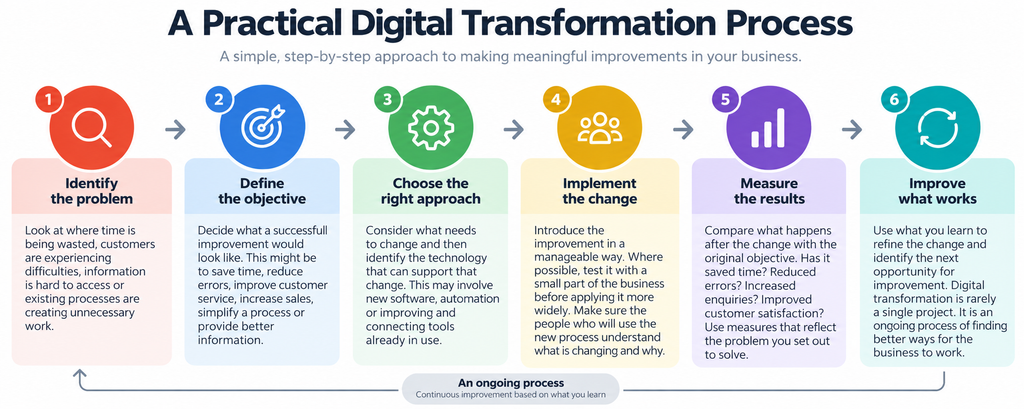
A simple process can help keep the focus on business improvement rather than technology.
Identify the problem
Start with a specific problem, inefficiency or opportunity. Look at where time is being wasted, customers are experiencing difficulties, information is hard to access or existing processes are creating unnecessary work.
Define the objective
Decide what a successful improvement would look like. The objective might be to save time, reduce errors, improve customer service, increase sales, simplify a process or provide better information.
Choose the right approach
Consider what needs to change and then identify the technology that can support that change. In some cases this may involve new software or automation. In others, improving an existing system or connecting tools already in use may be enough.
Implement the change
Introduce the improvement in a manageable way. Where possible, test it with a small part of the business before applying it more widely. Make sure the people who will use the new process understand what is changing and why.
Measure the results
Compare what happens after the change with the original objective. Has it saved time? Reduced errors? Increased enquiries? Improved customer satisfaction? The measures used should reflect the problem you originally set out to solve.
Improve what works
Use what you learn to refine the change and identify the next opportunity for improvement. Digital transformation is rarely a single project. It is an ongoing process of finding better ways for the business to work.
For a small business, this approach makes digital transformation more manageable. It allows improvements to be made gradually, while ensuring that investment in technology remains connected to a genuine business need.
What Can Digital Transformation Include?
Digital transformation can affect almost every part of a modern business.
Customer-facing changes might include a new website, e-commerce facilities, online booking, improved customer support or more personalised communications.
Internally, transformation might involve cloud-based systems, improved collaboration tools, automated workflows, better data collection or integration between previously separate systems.
Marketing can also be transformed through search engine optimisation, content marketing, email automation, analytics and improved use of customer data.
Increasingly, artificial intelligence is becoming another part of this picture, helping organisations analyse information, automate routine activities and support employees in their work.
The important point is that these technologies should support a defined business objective rather than being adopted simply because they are available.
Digital Transformation Is About People Too
Technology alone rarely transforms a business.
Employees need to understand why a change is being made, what problem it is intended to solve and how a new process or system will affect the way they work. Customers also need to find new digital services straightforward and useful.
The people who use an existing process every day can provide valuable insight before a change is made. They often know where delays occur, which tasks create unnecessary work and where existing systems cause frustration. Involving them early can help identify problems that might otherwise be missed.
Introducing a new system without considering the people who will use it can create resistance rather than improvement. Training may be needed, responsibilities may change and employees need an opportunity to understand how the new approach will help them rather than simply being told to use it.
The same principle applies to customers. A new online booking system, website feature or automated service is only an improvement if customers find it easier or more useful than what it replaced.
Successful digital transformation therefore needs to consider people, processes and technology together. The technology provides the tools, but the people using those tools ultimately determine whether the change delivers a genuine improvement.
Start Small and Measure the Results
Digital transformation does not have to happen as one large project.
For many SMEs, a more practical approach is to identify one or two areas where digital improvements could make a measurable difference.
Make the change, measure what happens and learn from the results.
Did it save time? Did more customers complete an enquiry? Did it reduce errors? Did website conversions improve? Did employees find the new process easier?
Those results can then inform the next stage.
This creates a cycle of improvement rather than a single transformation project.
Digital Transformation as Part of Your Strategy
Digital transformation should ultimately support what the organisation is trying to achieve.
That could mean improving efficiency, reaching new customers, providing a better customer experience, reducing costs or creating new products and services.
The technology will continue to change. The important skill is being able to identify which changes genuinely help the business.
That is why digital transformation works best as part of a wider digital strategy: understand where you are, decide where you want to go, use technology where it adds value, and measure whether it is actually making a difference.
Ready to Explore Digital Transformation?
Digital transformation does not have to mean replacing everything or making large investments in new technology. It starts with understanding where your business could work better and identifying practical improvements that make a real difference.
If you would like an independent view of where digital technology could improve your business, we can help you identify opportunities, set priorities and decide what to do next.
Contact us to discuss your digital transformation priorities.