
SEO 101: A Practical Introduction to Search Engine Optimisation
Introduction
Search Engine Optimisation, usually shortened to SEO, is the process of improving your website so that search engines can understand it and potential customers have a better chance of finding it.
The basic idea hasn’t changed dramatically since this article was first published. People still use search engines to find information, compare businesses, research products and look for services. What has changed is the way search engines understand websites and the increasingly varied ways in which they present information to users.
SEO has changed with them. It is no longer sensible to think of optimisation simply as adding keywords to pages or trying to acquire as many links as possible. Modern SEO involves useful content, website structure, technical performance, authority, user experience and an understanding of what people are actually trying to find when they search.
For small businesses, this can make SEO appear more complicated than it needs to be. You don’t need to understand every search engine algorithm or follow every development within the SEO industry. You do need a website that search engines can access and understand, useful information that answers the needs of your potential customers, and clear evidence of what your business does and why it can be trusted.
In this updated SEO 101, we’ll look at the fundamentals of Search Engine Optimisation, how the different elements fit together and the practical steps small businesses can take to build stronger and more sustainable visibility in search.
What Is SEO?
SEO stands for Search Engine Optimisation. It describes the work involved in improving a website so that search engines can find, understand and present its content to people carrying out relevant searches.
When someone enters a search into Google or another search engine, the search engine attempts to identify the information that will best answer what that person is looking for. SEO helps make it easier for search engines to understand what your website and individual pages are about and when they might be relevant to a particular search.
For a business, the objective isn’t simply to attract as many visitors as possible. A thousand visitors who have no interest in what you offer are considerably less useful than a smaller number of people actively looking for your products or services. Effective SEO therefore concentrates on attracting relevant visitors who have a genuine reason to engage with your business.
SEO involves several different areas of a website and its wider online presence. The content you publish, the way pages are structured, headings and page titles, internal links, website performance and accessibility can all contribute. Signals from outside your website, such as links, mentions and your wider reputation, can also help search engines understand your business and its authority.
This is why SEO shouldn’t be regarded as a single task performed after a website has been built. It works best when it is considered as part of the website itself — from its structure and technical foundations through to the content you create and maintain over time.
At its simplest, good SEO is about making your website easier for search engines to understand while making it more useful for the people you want to reach.
How Search Engines Find and Understand Your Website
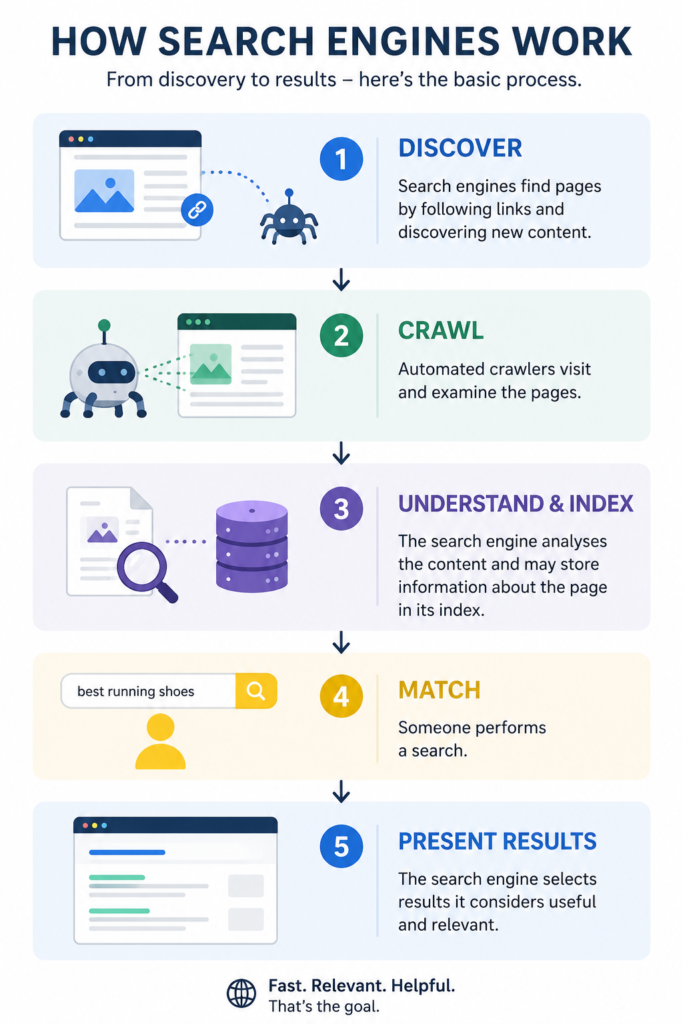
Before a page can appear in search results, a search engine first needs to discover it and understand what it contains. Although the technology behind this process is complex, the basic principles are relatively straightforward.
Search engines use automated programs, often called crawlers or bots, to discover pages across the web. They follow links from one page to another, revisit websites they already know about and discover new or updated content along the way.
Once a page has been discovered, the search engine analyses its content and structure. Page titles, headings, written content, images, links and other information all help provide context about what the page contains and the searches for which it might be useful.
Search engines can then store information about suitable pages within an index. When someone performs a search, the search engine can consider relevant pages from that index and determine which results are most likely to satisfy what the person is looking for.
This is one reason good website structure matters. Clear navigation and sensible internal links help visitors move around your website, but they also help search engines discover pages and understand how different pieces of content relate to one another.
You can also help search engines by maintaining an XML sitemap, using descriptive page titles and headings, avoiding unnecessary duplicate content and making sure important pages aren’t accidentally prevented from being crawled or indexed.
You don’t need to design your website for search engine robots. In most cases, creating a well-organised website with useful content and straightforward navigation benefits both search engines and the people who use it.
Why SEO Matters for Small Businesses
For a small business, being visible when potential customers are actively searching for the products or services you provide can be extremely valuable. SEO helps create that visibility.
Unlike many forms of marketing, search often begins with an existing need. Someone might be looking for an accountant, researching a new website, comparing local tradespeople or trying to solve a particular business problem. If your website provides a useful and relevant answer, search engines have an opportunity to connect that person with your business.
This is particularly important for smaller businesses competing against larger organisations with much bigger advertising budgets. Good organic visibility can’t guarantee that you will outrank a major competitor, but it can give a specialist or local business opportunities to appear for searches where its expertise, services or location are particularly relevant.
SEO can also support the wider credibility of your business. Potential customers may discover an article you have written, find one of your service pages or encounter your business through a local search. Each provides another opportunity for them to understand what you do and decide whether they want to learn more.
There is also a longer-term benefit. Advertising generally stops generating exposure when you stop paying for it. A useful, well-optimised page can continue attracting relevant visitors long after it was originally published, although it may need updating as information, competitors and search behaviour change.
SEO isn’t a quick route to guaranteed rankings or instant enquiries. It is an investment in making your website easier to discover and more useful to the people who are already searching for what your business provides.
The Three Main Areas of SEO
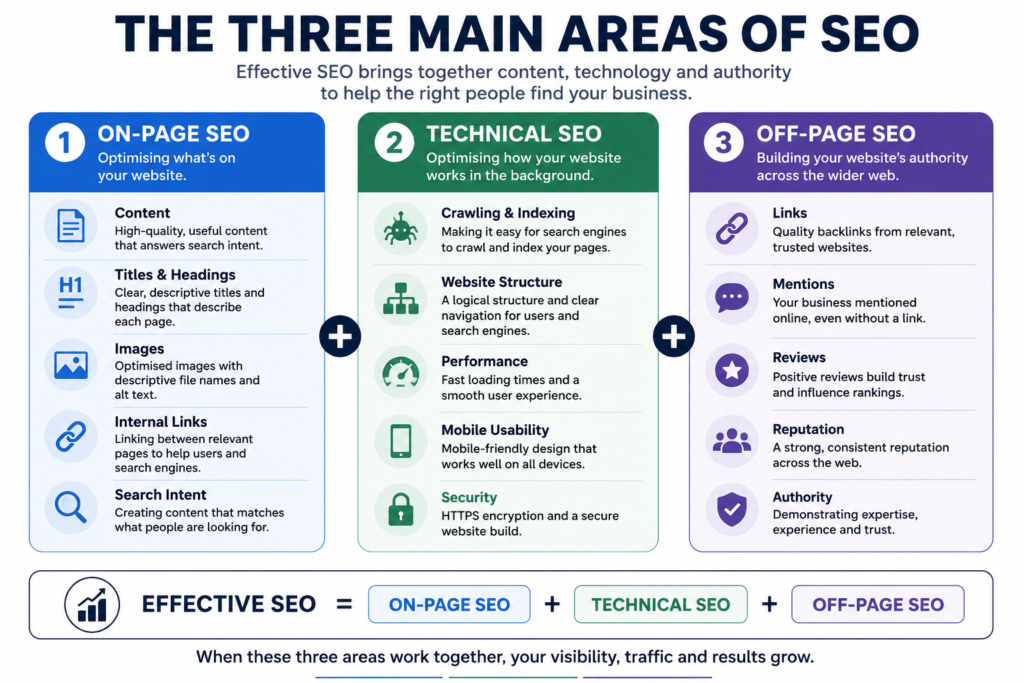
SEO covers many different activities, but most can be grouped into three broad areas: on-page SEO, off-page SEO and technical SEO. Understanding the difference between them makes it easier to see how the various parts of an SEO strategy work together.
On-Page SEO
On-page SEO covers the content and elements that appear within your website. This includes page titles, headings, written content, images, internal links and the way individual pages are organised.
The objective is to make each page useful to visitors while helping search engines understand its subject and purpose. Good on-page SEO starts with understanding what someone is looking for and creating content that provides a relevant and useful response.
Off-Page SEO
Off-page SEO concerns signals and activity beyond your own website that can contribute to its reputation and authority.
Links from other reputable websites are an important example, but off-page SEO is broader than link building alone. Business mentions, reviews, citations, professional profiles and wider recognition of your organisation can all contribute to the picture that exists around your business online.
Good off-page SEO is therefore closely connected with building a genuine reputation rather than simply trying to acquire links.
Technical SEO
Technical SEO focuses on ensuring that your website provides a sound technical foundation for both visitors and search engines.
This includes making sure search engines can crawl and index important pages, maintaining sensible website architecture, providing an XML sitemap, using secure HTTPS connections and addressing performance or mobile usability problems that could interfere with the experience of using the site.
These three areas shouldn’t be treated in isolation. Excellent content will achieve less if search engines cannot access it, while technically perfect pages won’t provide much value if their content is poor. Likewise, external authority is difficult to build around a website that offers little useful information.
Effective SEO brings all three together: useful and well-structured content, a technically sound website and a credible presence beyond the website itself.
Content and Search Intent
Creating content for SEO isn’t simply about deciding which keywords to include on a page. The more important question is what the person carrying out the search is actually trying to achieve.
This is known as search intent.
Someone searching for “what is SEO?” is probably looking for information and an explanation. Someone searching for “SEO consultant near me” is much more likely to be looking for a business or professional they can contact. Although both searches concern SEO, the information each person needs is very different.
Understanding this intent helps you create pages that genuinely answer the needs behind a search. An educational article might explain a subject in detail, while a service page should clearly describe what you offer, who it is for and how someone can take the next step.
This is also why creating large numbers of pages around slightly different variations of the same keyword is rarely useful. If several searches have essentially the same intent, one comprehensive and well-structured page may serve visitors better than several thin pages repeating similar information.
For small businesses, some of the best content ideas often come directly from customers. Think about the questions people ask before buying, the problems they regularly need help solving and the information they need before deciding whether your product or service is right for them.
Create content around those genuine needs rather than writing purely for search engines.
When the purpose of a page matches the intention behind a search, SEO and good content strategy begin working towards the same objective: providing the right information to the right person at the right time.
Local SEO
For businesses that serve customers within a particular town, city or region, local SEO is an especially important part of search visibility.
Local SEO focuses on helping people find businesses that are relevant to a particular geographic area. Searches such as “electrician near me”, “accountant in Oxted” or “website consultant Surrey” have a clear local element, and search engines can use location alongside other signals to provide appropriate results.
Your Google Business Profile plays an important role in this. Accurate business information, appropriate categories, services, photographs and genuine customer reviews can all help potential customers understand what your business offers and where it operates.
Your website also matters. Clearly describing the areas you genuinely serve, providing useful information about your services and keeping your business details consistent across your online presence can help establish the relationship between your business, its services and its location.
Local SEO isn’t about creating dozens of almost identical pages with different town names or repeatedly adding locations to your content. The objective is to provide genuine evidence that your business serves the places and customers you say it does.
For many small businesses, local visibility can be more valuable than attracting visitors from across the country. Being found by a smaller number of people who are nearby and actively searching for your services is often far more useful than generating large volumes of irrelevant traffic.
For a more detailed look at one of the most important elements of local search, see our Complete Small Business Guide to Google Business Profile.
SEO in the Age of AI Search
Search is continuing to evolve. Traditional lists of search results are increasingly being supplemented by AI-generated summaries, conversational search tools and other ways of presenting information directly to users.
This doesn’t mean that SEO is becoming irrelevant. It does mean that businesses need to think more broadly about online visibility.
Search engines and AI-powered systems need useful, understandable and trustworthy information from which to provide answers. Creating original content that demonstrates genuine experience and expertise therefore remains important, particularly when that content answers real questions clearly and provides information that is difficult to find elsewhere.
You may also encounter the term Generative Engine Optimisation, or GEO. This is generally used to describe attempts to improve the visibility of content within AI-generated answers and conversational search experiences. GEO shouldn’t be seen as a replacement for SEO. Many of the principles overlap: clear content, strong website structure, recognised authority, accurate information and a credible presence across the wider web.
This also makes the principles of E-E-A-T increasingly relevant. Demonstrating real experience, expertise, authority and trust can help establish why your business and its content deserve attention, regardless of whether someone discovers you through a conventional search result or an AI-assisted search experience.
Small businesses shouldn’t feel compelled to chase every new development in search technology. Concentrate instead on creating genuinely useful information, maintaining a technically sound website and building a credible online presence.
The way search results are presented will continue to change. Providing useful answers and demonstrating why your business can be trusted is a much more sustainable strategy than trying to optimise for every new search feature as it appears.

Five Practical SEO Improvements You Can Make Today
SEO can involve significant long-term work, but there are also useful improvements you can make without redesigning your website or beginning a major optimisation project.
1. Review Your Page Titles and Headings
Look at the most important pages on your website and check whether their titles and main headings clearly describe what each page is about. They should make sense to a visitor as well as helping search engines understand the content.
2. Improve One Important Page
Choose a page that matters to your business and read it from a potential customer’s perspective. Does it answer the questions someone is likely to have? Is important information missing? Improving an existing page can sometimes be more valuable than continually creating new ones.
3. Check Your Internal Links
Make sure important pages aren’t isolated. Add relevant links between related services, articles and other useful content so visitors can easily explore the website. Clear internal linking also helps search engines understand the relationship between your pages.
4. Check Your Google Business Profile
If local customers matter to your business, review your Google Business Profile. Check your contact information, opening hours, services, photographs and recent reviews. Make sure the information shown by Google still accurately represents your business.
5. Look at Your Website on a Mobile Device
Visit your website using your own phone and use it as a customer would. Check whether the text is easy to read, navigation works properly, pages load reasonably quickly and buttons and forms are straightforward to use.
These five actions won’t constitute a complete SEO strategy, but they provide a useful starting point. More importantly, they encourage the habit that effective SEO requires: regularly reviewing your website, identifying weaknesses and making worthwhile improvements rather than treating optimisation as a one-off exercise.
SEO Is a Long-Term Process
One of the most common misconceptions about SEO is that it is a task you complete once and then forget about. In reality, effective SEO is an ongoing process of reviewing, improving and adapting your website over time.
Search behaviour changes. Competitors improve their websites. New content appears, technology develops and the products or services your own business provides may evolve. A page that performed well several years ago may gradually become less useful if the information it contains is no longer current.
This doesn’t mean you need to make constant changes simply for the sake of SEO. It means periodically reviewing what is working and identifying where genuine improvements can be made.
Website analytics and Google Search Console can help you understand which pages attract visitors, what searches are generating visibility and whether there are technical or indexing problems that need attention. This information can help you decide where to concentrate your efforts rather than making changes based purely on assumptions.
Existing content should also be reviewed. Some articles may need updating, several similar pages might be better consolidated into one stronger resource, and outdated content may occasionally be better removed altogether. Creating more content isn’t always the answer; improving what you already have can be equally valuable.
SEO should therefore be viewed as continuous improvement rather than a campaign with a fixed finishing point. Make useful changes, monitor the results, learn from what happens and use that information to decide what to improve next.
Small improvements made consistently over time can build a much stronger search presence than occasional bursts of activity followed by years of neglect.
Conclusion
SEO has changed considerably over the years, but its fundamental purpose remains straightforward: helping search engines understand your website and helping the right people find useful information about your business.
Effective SEO isn’t built around shortcuts or attempts to manipulate search rankings. It comes from combining useful content with a well-structured, technically sound website and developing genuine authority and credibility beyond your own pages.
For small businesses, that means concentrating on the areas that genuinely matter. Understand what your potential customers are searching for, create content that answers their needs, make your website easy to use and navigate, maintain accurate business information and continue improving your online presence over time.
You don’t need to become an SEO specialist to benefit from these principles. Start with the fundamentals, make sensible improvements and use the information available through tools such as website analytics and Google Search Console to understand what is working.
Search technology will continue to evolve, particularly as AI becomes a greater part of how people discover information. The terminology and tools may change, but useful content, genuine expertise, a technically accessible website and a trustworthy business will remain strong foundations.
SEO isn’t about chasing search engines. It is about making your business easier to discover when the people you want to reach are looking for what you provide.
Want to Improve Your Search Visibility?
SEO doesn’t need to begin with a complicated strategy. Start by understanding how your website is performing, identify the areas that need attention and concentrate on improvements that will make a genuine difference to your customers and your search visibility.
For more practical advice on SEO, websites, local search and digital strategy, explore our latest articles or subscribe to the Digital Strategy newsletter for future articles, checklists and downloadable resources.
If you’d prefer an independent assessment of your website and search presence, Digital Direction provides practical SEO and digital consultancy to help small businesses understand what is working, what could be improved and where to focus next.