Artificial Intelligence and Digital Strategy: What It Means for Your Business

Introduction
Artificial intelligence has quickly become one of the most discussed areas of digital technology. Tools that can generate text and images, analyse information, automate tasks and answer questions are now readily available to businesses of almost every size.
For small and medium-sized businesses, the important question is not whether AI is receiving attention, but where it can genuinely provide value.
Used effectively, artificial intelligence can become part of a wider digital strategy. Used without a clear purpose, it can simply become another piece of technology that consumes time without delivering meaningful results.
What Is Artificial Intelligence?
Artificial intelligence describes computer systems capable of performing tasks that would traditionally require aspects of human intelligence.
AI can identify patterns in data, interpret language, generate content, make recommendations and automate elements of decision-making.
Generative AI has made these capabilities much more accessible. Businesses no longer necessarily need specialist technical teams to experiment with AI. Many familiar business applications now incorporate AI features directly.
However, accessibility does not remove the need for careful consideration about how and where the technology should be used.
How Can Businesses Use AI?
There are already many practical ways that small and medium-sized businesses can use artificial intelligence. The most useful applications are often those that help people work more efficiently, make better use of information or reduce the time spent on repetitive tasks.
AI can support research by helping to gather ideas, summarise information and identify important points within large amounts of material. It can also help employees explore a subject or prepare an initial starting point for further investigation. The results still need to be checked, but AI can reduce some of the time involved in the early stages of research.
Content and marketing are another common area of use. AI can help generate ideas, develop content plans, produce initial drafts and adapt existing material for different purposes. It can also assist with analysing marketing information and identifying patterns in customer behaviour. However, the final content should still reflect the knowledge, experience and individual character of the business.
Customer service can also benefit from AI. Businesses may use it to help answer routine questions, organise enquiries or provide employees with quicker access to information when responding to customers. The objective should be to improve the customer experience rather than simply remove human contact.
Administrative tasks can provide some of the most practical opportunities. AI can help summarise documents, organise information, prepare meeting notes, categorise enquiries and assist with other repetitive activities that consume staff time.
Businesses can also use AI to analyse information. It may help identify trends in sales, customer behaviour, website activity or other business data that would otherwise take considerable time to examine manually. This can support decision-making, although important decisions should not be based on AI output without appropriate human judgement.
The aim is not to introduce AI everywhere. It is to identify particular activities where it can save time, improve efficiency, provide useful insight or help employees do their jobs more effectively.
AI Needs a Business Purpose
The rapid development of AI makes it tempting to start with the technology. New tools appear constantly, often accompanied by claims about how they can transform the way businesses work.
A better approach is to start with a business problem.
Is a repetitive task consuming too much time? Is important information difficult to analyse? Could customers receive answers more quickly? Are employees spending time searching for information that could be easier to access? Is there an existing process that could be made more efficient?
Once the requirement is understood, consider what improvement you actually want to achieve. That might be saving staff time, reducing administrative work, improving response times, identifying useful information more quickly or helping employees make better decisions.
Only then should you consider whether AI is an appropriate solution.
In some cases, AI may provide a significant improvement. In others, changing an existing process, improving the way current software is used or introducing a simpler form of automation may achieve the same objective more effectively.
This is why AI should form part of a wider digital strategy rather than becoming a strategy in itself. The important question is not “How can we use AI?” but “What are we trying to improve, and can AI help us do it?”
Once that question has been answered, you can take a practical approach to testing whether AI can deliver the expected benefit.
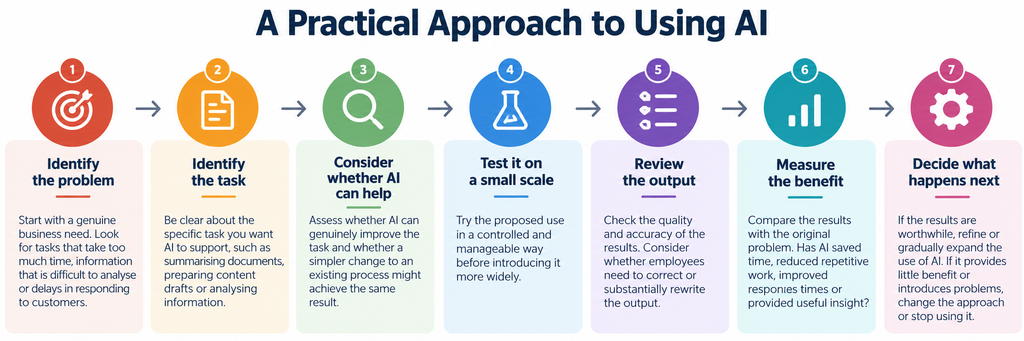
A Practical Approach to Using AI
Introducing AI into a business does not need to begin with a major project. A better approach is often to identify one specific task or problem where AI might provide a measurable benefit, test it carefully and learn from the results.
Identify the problem
Start with a genuine business need. Look for repetitive tasks that consume too much time, information that is difficult to analyse, delays in responding to customers or activities where employees could work more efficiently.
Identify the task
Be clear about the particular task you want AI to support. Rather than deciding to “use AI”, define exactly what you want it to help with, such as summarising documents, preparing initial content drafts, analysing information or handling routine enquiries.
Consider whether AI can help
AI will not be the right solution to every problem. Consider whether it can genuinely improve the task and whether a simpler change to an existing process or system might achieve the same result.
Test it on a small scale
Try the proposed use in a controlled and manageable way before introducing it more widely. This makes it easier to understand how well the technology performs without creating unnecessary disruption.
Review the output
Check the quality and accuracy of the results. Consider whether employees still need to correct or substantially rewrite the output and whether there are any concerns involving confidential information, customers or other business data.
Measure the benefit
Compare the results with the original problem. Has AI saved time, reduced repetitive work, improved response times, provided useful insight or helped employees work more effectively?
Decide what happens next
If the results are worthwhile, the use of AI can be refined or gradually expanded. If it provides little benefit or introduces unnecessary problems, change the approach or stop using it for that task.
This creates a practical cycle of testing, learning and improvement. It allows a business to explore the potential of AI while keeping its use connected to genuine business needs rather than adopting technology simply because it is available.
Understand the Limitations
AI can be extremely useful, but its output should not automatically be assumed to be accurate or appropriate.
AI systems can produce incorrect information, misunderstand context and generate answers that appear convincing even when they contain errors. This means that important information should be checked before it is used, particularly when it will be published, sent to customers or used to support a business decision.
Businesses also need to think carefully about the information they provide to AI tools. Confidential business information, customer details, commercially sensitive material or personal data should not be entered into a system without understanding how that information will be handled, stored and used.
Copyright and ownership can also require consideration. AI may help create text, images, ideas and other material, but businesses should understand the terms of the tools they use and avoid assuming that every AI-generated output can automatically be used without restriction.
There is also a risk of becoming too dependent on AI. An output may be quick and well presented without necessarily being the best answer. Employees still need to apply their own knowledge, experience and judgement rather than accepting AI recommendations simply because they have been produced by a sophisticated system.
The level of checking and human oversight should reflect the importance of the task. Using AI to generate ideas for an internal meeting presents very different risks from using it to provide information to customers, analyse sensitive data or influence an important business decision.
AI should therefore be treated as a tool that supports people rather than a source that can always be trusted without question. The greater the potential consequences of an error, the greater the need for appropriate human review.
Keep People in the Process
AI can support people in many areas of a business, but it does not remove the need for human knowledge, experience and judgement.
Employees understand the business, its customers and the circumstances in which decisions are being made. They can recognise when information does not look right, when an unusual situation requires a different approach or when a customer needs personal attention rather than an automated response.
This is particularly important when AI is used to create content, communicate with customers, analyse information or support decisions. AI can help produce an initial response, identify patterns or suggest possible actions, but someone still needs to decide whether the result is appropriate.
People should also understand when AI is being used and what their responsibilities are. If employees are expected to check AI-generated work, they need to know what they are checking for and when an issue should be referred to someone else.
The objective should be to use AI where it genuinely helps people do their jobs more effectively. Automating repetitive work may give employees more time for activities that require creativity, specialist knowledge, problem solving or personal interaction.
The most effective use of AI is therefore often a combination of technology and human capability. AI can provide speed and assistance, while people provide context, experience, judgement and accountability.
Start With Small, Practical Uses
Most SMEs do not need an organisation-wide AI programme.
A better starting point is often a clearly defined task where the potential benefit can be measured.
For example, a business might experiment with AI to help summarise documents, develop initial content ideas or reduce time spent on a repetitive administrative activity.
The results can then be assessed.
Did it save time? Did the quality remain acceptable? Did employees find it useful? Were there unexpected problems?
Successful experiments can be expanded while unsuccessful ones can be stopped without significant disruption.
AI as Part of Your Digital Strategy
Artificial intelligence will continue to develop, and the individual tools businesses use today will undoubtedly change.
The more important capability is therefore not learning one particular AI product. It is developing the ability to recognise where AI can contribute to business objectives.
For SMEs, that means remaining curious without adopting technology simply because it is fashionable.
When AI is connected to genuine business needs, introduced carefully and its results are measured, it can become another valuable component of a practical digital strategy.
Ready to Explore How AI Could Help Your Business?
Artificial intelligence can create useful opportunities for small and medium-sized businesses, but the starting point should always be a genuine business need rather than the technology itself.
If you are unsure where AI could provide practical value, how it might fit into your existing processes, or which opportunities are worth exploring, we can help you identify priorities and consider the most appropriate next steps.
Contact us to discuss how artificial intelligence could support your wider digital strategy.