
Anatomy of SERPs: Understanding Modern Search Results
Introduction
Search engine results pages have changed considerably. What was once largely a list of website links can now contain advertisements, maps, images, videos, featured answers, business information and AI-generated results — sometimes all within the same search.
These pages are known as SERPs, short for Search Engine Results Pages. They are the pages a search engine displays after someone enters a query, and understanding how they work is an important part of modern search engine optimisation.
For businesses, this matters because appearing in search is no longer simply about achieving one position in a list of organic results. Depending on what someone searches for, there may be several different opportunities to become visible.
A local business might appear within a map-based result, an informational article could be surfaced prominently in response to a question, while images, videos or other search features may provide additional routes to discovery.
The exact layout can also change according to the search itself. Google attempts to present the type of information it considers most useful for that particular query, which means two searches can produce very different-looking results pages.
In this guide, we’ll look at the main elements that can appear within modern SERPs, what they mean for businesses and how understanding them can help you think more broadly about your search visibility.
What Is a SERP?
SERP stands for Search Engine Results Page. It is the page you see after entering a search query into Google or another search engine.
Traditionally, a SERP consisted mainly of a list of links to web pages that the search engine considered relevant to the query. Those organic listings remain an important part of search results, but modern SERPs can contain considerably more.
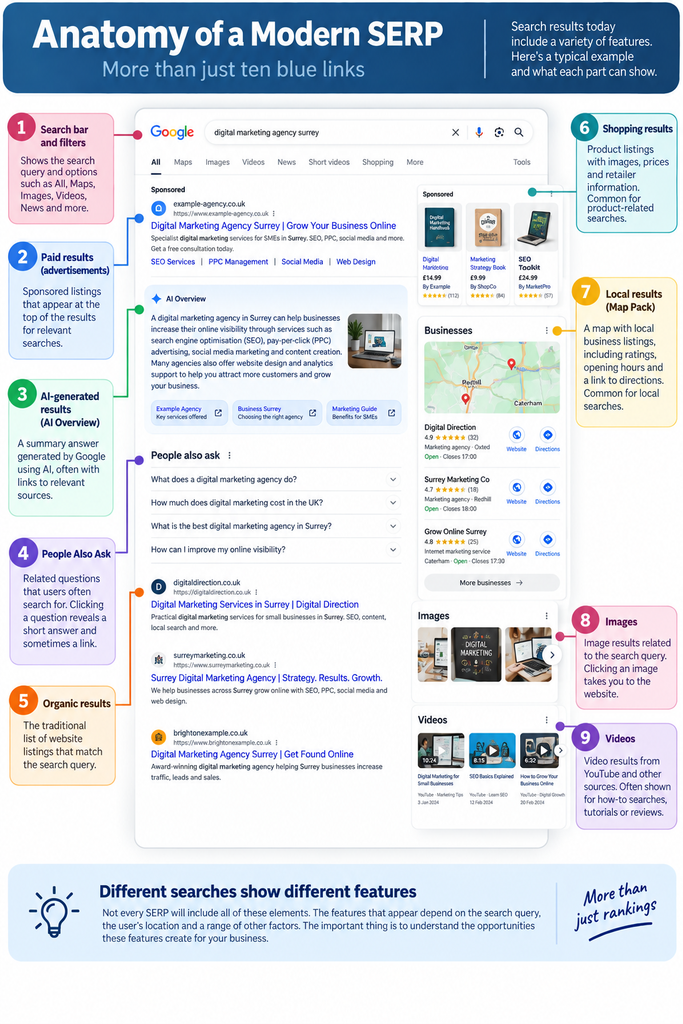
Depending on the search, you might see paid advertisements, local business results, maps, images, videos, featured answers, related questions, shopping results or information about a particular person, organisation or subject. AI-generated results may also appear for some searches.
Each of these elements provides information in a different way. Some direct people to websites, while others may answer part or all of a question directly within the search results.
This means that a business’s visibility in search can no longer be understood simply by asking, “Where does my website rank?” It is also useful to understand which search features appear for the searches that matter to your customers and where your business or content might have an opportunity to appear.
Understanding the anatomy of a SERP is therefore about understanding the different ways information can be presented — and the different routes through which potential customers may discover your business.
Why Search Results Don’t All Look the Same
Google does not display exactly the same type of results for every search. The layout of a SERP can change depending on what someone is looking for and the type of information that is likely to satisfy that search.
A search for a local service, for example, may produce a map and nearby businesses prominently within the results. A question seeking information might generate an AI-generated response, a featured answer or a selection of related questions. Other searches may emphasise images, videos, products or traditional website listings.
This is closely connected with search intent — the reason behind the search. Someone looking for information has a different need from someone trying to find a particular business, compare products or locate a service nearby.
The results can also vary according to factors such as location, device and the precise wording of the query. This means that the SERP you see when searching for your own business or services may not be identical to the one seen by a potential customer.
For SEO, the important point is that there is no single search results layout to optimise for. Understanding what actually appears for the searches relevant to your business can help you identify which types of content and search features offer the most useful opportunities for visibility.
Paid Search Results
Paid search results are advertisements that can appear within the SERP, often above or alongside organic results. On Google, these advertisements are clearly labelled to distinguish them from unpaid listings.
Businesses use paid search advertising to appear for searches that are relevant to their products or services. Advertisers can target particular keywords and audiences and generally pay when someone clicks on their advertisement.
For searches with strong commercial intent, paid results can occupy some of the most prominent positions on the page. This means that the first result a user sees is not necessarily the website that ranks highest organically.
Paid search and SEO are different approaches. Paying for advertising does not improve a website’s organic ranking, while achieving a strong organic position does not guarantee that your result will appear above advertisements.
However, both can form part of a wider search strategy. Paid advertising can provide immediate visibility for selected searches, while SEO is generally focused on developing sustainable organic visibility over time.
When examining a SERP, it is therefore important to identify which results are advertisements and which have earned their position through organic search.
Traditional Organic Search Results
Traditional organic results are the unpaid website listings that have formed the familiar core of search results for many years. They usually include a page title, website address and a short description or extract from the page.
Google selects and orders these results according to what it considers most relevant and useful for the search. Unlike paid advertising, businesses cannot pay Google to achieve a higher position within organic results.
For businesses, these listings remain an important source of search visibility. A well-optimised service page, useful article or other relevant content can provide a route from a search directly to your website, where you have greater control over the information and experience provided to the visitor.
The appearance of an organic result is not entirely under your control. Google may change the displayed title or description when it believes different wording will better represent the page for a particular search.
Traditional organic listings also have to compete for attention with the many other elements that can now appear on a SERP. Advertisements, maps, AI-generated responses, images, videos and other features can all occupy space that was once dominated by conventional website links.
Organic search therefore remains important, but modern SEO requires a broader view of visibility than simply trying to achieve the highest possible position among the traditional listings.
AI-Generated Search Results
One of the most significant changes to modern search results is the introduction of generative AI directly into Google Search.
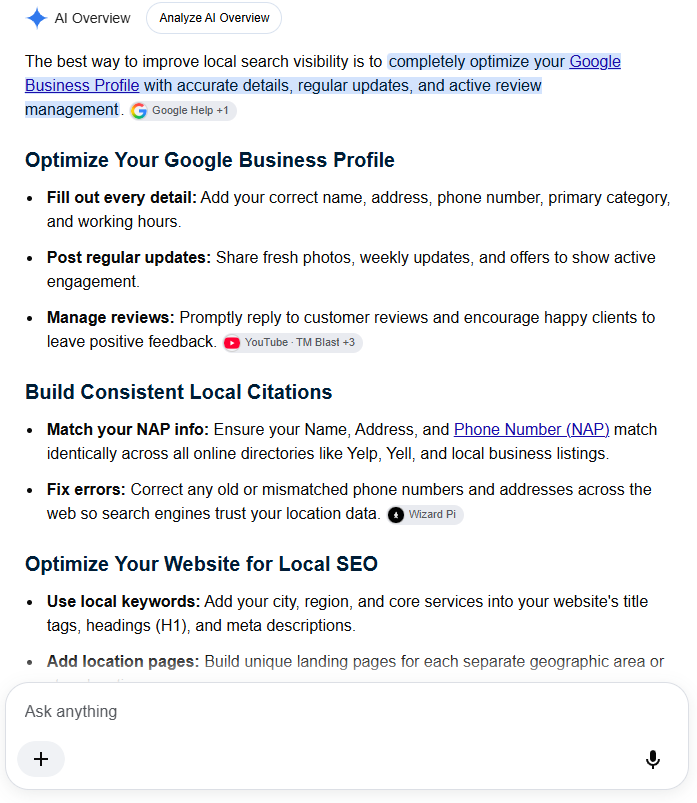
Google’s AI Overviews can appear within the search results when its systems determine that an AI-generated response would be helpful. Rather than simply presenting a list of individual web pages, an AI Overview can bring together information to provide a summary or answer to a user’s question.
These results can include links to supporting websites, allowing users to explore the sources and subjects in greater detail. Google continues to develop how these links are presented, including links placed directly within AI-generated responses.
Google has also developed AI Mode, which provides a more conversational search experience. It is designed for more complex questions and allows people to ask follow-up questions while retaining the context of the original search.
For businesses and website owners, this changes the idea of search visibility again. Your content may potentially be discovered or referenced within an AI-generated search experience as well as appearing as a traditional organic listing.
There is no separate shortcut for optimising content specifically for Google’s AI search features. The fundamentals remain familiar: create useful, original and trustworthy content, make it easy for search engines to understand, and provide information that genuinely helps the people searching for it.
AI-generated results are therefore not a replacement for SEO. They are another way in which search engines can discover, interpret and present useful information from across the web.
Featured Snippets and Direct Answers
Some searches produce an answer prominently within the results page rather than relying solely on the traditional list of website links.
A featured snippet typically extracts information from a web page that Google considers particularly useful for answering the query. It may appear as a short paragraph, list, table or other format, together with a link to the source page.
These results are particularly common for searches phrased as questions or where someone is looking for a concise explanation, definition or set of instructions. They allow users to obtain useful information quickly while still providing an opportunity to visit the source for more detail.
Google can also display information directly within the SERP for straightforward factual searches. Depending on the query, someone may see information such as calculations, conversions, dates or other immediate answers without needing to visit another website.
For businesses producing informational content, featured snippets demonstrate the value of answering questions clearly. Well-structured pages with descriptive headings, concise explanations and useful supporting detail make information easier for both visitors and search engines to understand.
However, featured snippets should not become an optimisation target at the expense of the reader. The priority remains creating a genuinely useful page that answers the searcher’s question thoroughly. A prominent appearance within the SERP is a potential additional benefit, not the sole reason for creating the content.
People Also Ask
Many Google search results include a People Also Ask section containing questions related to the original search.
Each question can be expanded to reveal a short answer, usually drawn from a web page, together with a link to the source. As users open questions, Google may display additional related questions, allowing them to explore a subject without starting a completely new search.
For businesses, People Also Ask results provide useful insight into the questions people have around a particular topic. They can reveal concerns, comparisons and follow-up questions that may not be obvious from the original search term alone.
This can be particularly useful when planning website content. If customers regularly ask similar questions, answering them clearly within service pages, guides or articles can make your content more useful and comprehensive.
The objective should not be to create dozens of short answers simply in an attempt to appear within People Also Ask. Instead, use these questions as another way of understanding what your audience wants to know and make sure your content provides clear, useful answers where they are relevant.
People Also Ask demonstrates an important characteristic of modern SERPs: a single search can lead users through a much broader journey of related questions and information.
Local Search Results and the Map Pack
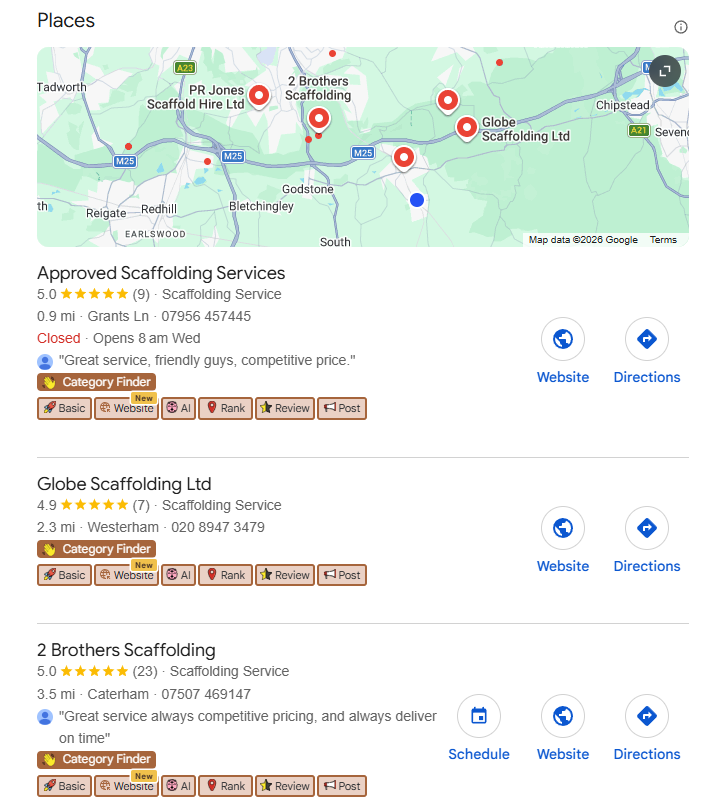
For searches with local intent, Google may display a group of nearby businesses prominently within the search results. This is commonly referred to as the Local Pack or Map Pack.
These results typically combine a map with selected business listings and can include information such as business names, reviews, opening hours, photographs and other details. Users can explore the results further through Google Maps or individual business profiles.
For a small business serving a particular geographic area, appearing within these results can be extremely valuable. Someone searching for a service nearby may encounter the Map Pack before reaching the traditional organic website listings further down the page.
Google Business Profile plays a central role in this type of visibility. Keeping your profile accurate and complete, selecting appropriate business categories, adding useful information and photographs, and encouraging genuine customer reviews can all contribute to a stronger local presence.
Local search also demonstrates why modern SEO cannot be viewed purely in terms of website rankings. A business may have visibility through its Google Business Profile and Maps as well as through pages from its website.
For businesses that depend on local customers, understanding and managing this part of the SERP should therefore form an important part of their wider search strategy.
Images, Videos and Other Rich Results
Modern search results are not limited to text. Depending on the query, Google may display images, videos and other visually enhanced results alongside or between traditional website listings.
Image results can be particularly prominent when the search has a strong visual element. Products, places, designs, food, people and how-to subjects can all generate image-based results, giving businesses another opportunity to be discovered through content published on their websites.
Video can also occupy significant space within a SERP. Google may display individual videos or groups of video results when watching something is likely to help answer the searcher’s question. Tutorials, demonstrations, explanations and product information are obvious examples where video may be particularly useful.
Other search results can include additional information beyond the conventional page title and description. Depending on the content and search, users may see elements such as ratings, prices, availability, event information or other details directly within the result.
Some of these enhanced appearances can be supported by structured data — information added to a web page to help search engines understand particular types of content. However, adding structured data does not guarantee that an enhanced result will be displayed.
For businesses, the important lesson is that useful content can take many forms. Relevant images, helpful videos and clearly structured information can improve the experience on your website while also creating additional opportunities for visibility within modern search results.
Knowledge Panels and Business Information
Some searches display a Knowledge Panel containing information about a business, organisation, person, place or other recognised entity. These panels are designed to give users a quick overview without requiring them to visit several different websites.
The information displayed can vary considerably. A Knowledge Panel might include a name, description, images, website link, location, contact information, social profiles and other relevant facts gathered from sources that Google considers appropriate.
For businesses, this highlights the importance of maintaining a clear and consistent presence across the web. Google may use information from your website, Google Business Profile and other trusted sources to understand your business and how it relates to information elsewhere online.
Knowledge Panels should not be confused with the local business information displayed through Google Business Profile. They can look similar in some searches, but they are different search features drawing on different sources of information.
You cannot simply create a Knowledge Panel in the same way that you can create a Google Business Profile. Instead, concentrate on making information about your business accurate, consistent and easy to understand wherever it legitimately appears online.
This is another example of why search visibility extends beyond achieving a traditional organic ranking. The clearer and more credible your wider digital presence becomes, the easier it is for both people and search engines to understand who you are and what your business does.
What Do Modern SERPs Mean for SEO?
Modern search results mean that SEO can no longer be thought of simply as trying to move a web page higher in a list of ten blue links.
Traditional organic rankings remain important, but they now exist alongside paid advertisements, AI-generated results, featured snippets, People Also Ask, local results, images, videos and other search features. Depending on the query, some of these may appear before the first conventional organic listing.
This creates both challenges and opportunities. A business may have to compete with more elements for attention, but it may also have more than one way to become visible.
The type of content you create should therefore reflect what people are searching for and how Google presents results for those searches. A local service may benefit from strong Google Business Profile visibility, while a detailed guide might have opportunities within organic results, AI-generated experiences, related questions or other informational features.
This reinforces the importance of looking beyond individual keywords. Search intent, useful content, on-page optimisation, technical performance, business reputation and authority all contribute to a broader search presence.
It is also worth examining the actual SERPs for searches that matter to your business. Look at which features appear, what types of pages are being shown and how competitors are represented. This can provide useful clues about what searchers are looking for and where opportunities may exist.
Modern SEO is therefore increasingly about achieving useful visibility across the search experience, rather than focusing exclusively on a single ranking position.
You Don’t Have to Rank Number One to Be Visible
For many years, SEO success was often discussed in terms of achieving the number one organic position for a particular search. That position can still be valuable, but modern SERPs make search visibility more complicated than a single ranking number.
A business might appear within the Map Pack, have an image or video displayed prominently, be referenced within an AI-generated result or have content surfaced through another search feature. In some cases, these appearances may attract attention before users reach the highest traditional organic listing.
The same business can also appear more than once within a SERP. For example, its Google Business Profile might be visible within local results while a service page or article from its website appears elsewhere on the page.
This means that measuring SEO purely by whether a page ranks first can give an incomplete picture. Rankings remain useful, but impressions, clicks, search features and the different pages through which people discover your business can provide a broader understanding of search performance.
The objective should be to achieve useful visibility where your potential customers are looking. Sometimes that may mean a high organic ranking; in other cases, a local result, useful image, video or another SERP feature may provide an equally valuable route to your business.
Modern search visibility is therefore less about owning one position and more about creating multiple opportunities to be discovered.
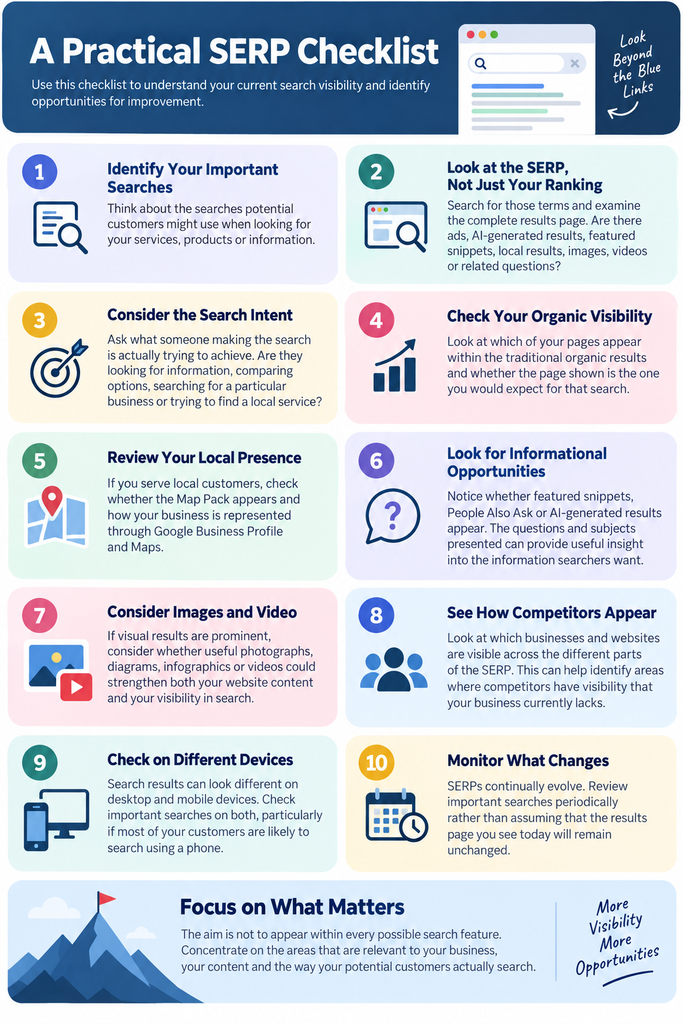
A Practical SERP Checklist
Understanding the different elements of a search results page is useful, but the real value comes from applying that knowledge to the searches that matter to your business.
Use this checklist to examine your current search visibility and identify where there may be opportunities for improvement.
1. Identify Your Important Searches
Think about the searches potential customers might use when looking for your services, products or information. Concentrate on searches that have a genuine connection with your business rather than trying to monitor every possible keyword.
2. Look at the SERP, Not Just Your Ranking
Search for those terms and examine the complete results page. Are there advertisements, AI-generated results, featured snippets, local results, images, videos or related questions alongside the traditional organic listings?
3. Consider the Search Intent
Ask what someone making the search is actually trying to achieve. Are they looking for information, comparing options, searching for a particular business or trying to find a local service?
4. Check Your Organic Visibility
Look at which of your pages appear within the traditional organic results and whether the page shown is the one you would expect for that search.
5. Review Your Local Presence
If you serve local customers, check whether the Map Pack appears and how your business is represented through Google Business Profile and Maps.
6. Look for Informational Opportunities
Notice whether featured snippets, People Also Ask or AI-generated results appear. The questions and subjects presented can provide useful insight into the information searchers want.
7. Consider Images and Video
If visual results are prominent, consider whether useful photographs, diagrams, infographics or videos could strengthen both your website content and your visibility in search.
8. See How Competitors Appear
Look at which businesses and websites are visible across the different parts of the SERP. This can help identify areas where competitors have visibility that your business currently lacks.
9. Check on Different Devices
Search results can look different on desktop and mobile devices. Check important searches on both, particularly if most of your customers are likely to search using a phone.
10. Monitor What Changes
SERPs continually evolve. Review important searches periodically rather than assuming that the results page you see today will remain unchanged.
The aim is not to appear within every possible search feature. Concentrate on the areas that are relevant to your business, your content and the way your potential customers actually search.
Conclusion
Search engine results pages have evolved far beyond the traditional list of website links. Paid advertising, organic results, AI-generated responses, featured snippets, related questions, local results, images, videos and knowledge panels can all compete for attention within the same search experience.
For businesses, this means that search visibility should no longer be judged by one organic ranking alone. There may be several different ways for potential customers to encounter your business, depending on what they search for and how Google chooses to present the results.
The starting point is understanding the searches that matter to your customers. Look at the SERPs themselves, consider the intent behind each search and identify which features are most relevant to your business and the content you provide.
You do not need to appear everywhere. A local business may benefit most from strong local visibility, while another business may gain more from useful informational content, images, videos or traditional organic results.
SEO remains about helping search engines understand useful, relevant content and connecting that content with the people looking for it. What has changed is the number of different ways that connection can now happen.
Understanding the anatomy of modern SERPs helps you see those opportunities — and develop a search strategy based on visibility across the whole results page rather than focusing on a single position.
Want to Understand How Your Business Appears in Search?
Knowing how search results are structured is useful, but the next step is understanding where your own business appears within them.
Start with the searches that matter most to your customers. Look beyond your website’s organic position and consider the complete results page. Are competitors appearing in local results? Are images, videos, related questions or AI-generated results prominent? Are there opportunities your current SEO activity may be overlooking?
Regularly reviewing these results can help you understand how people are finding businesses like yours and where improvements to your website, content or wider online presence could strengthen your visibility.
For more practical guidance, explore our Digital Strategy articles on SEO 101, On-Page SEO, Off-Page SEO and Google Business Profile. Together, they provide a broader understanding of the different elements that contribute to search visibility.
You can also subscribe to the Digital Strategy newsletter for future articles, guides and practical advice on SEO, websites and digital strategy.