
What Is Digital Strategy and Why Every Small Business Needs One

Digital Strategy “is a plan that uses digital resources to achieve one or more objectives”
Although this definition is true, it is an oversimplification. Some people say that a digital strategy is simply digital marketing. Marketing is certainly an important part of the picture, but a successful digital strategy goes much further than that. It considers every aspect of how a business uses digital technology to achieve its goals.
For many small businesses, a website, Facebook page or Google Business Profile has evolved over time rather than being developed as part of a clear plan. New tools are added, social media accounts are created, and marketing activities begin without considering how they all fit together. The result is often an online presence that works hard but doesn’t work together.
A digital strategy brings these individual elements into a single, coordinated plan. It helps you understand where your business is today, where you want it to be, and the practical steps needed to get there.
Digital Strategy is a path, a route to success online. Like any journey, before you can begin, you need to know where you are starting from, and where you’re going.
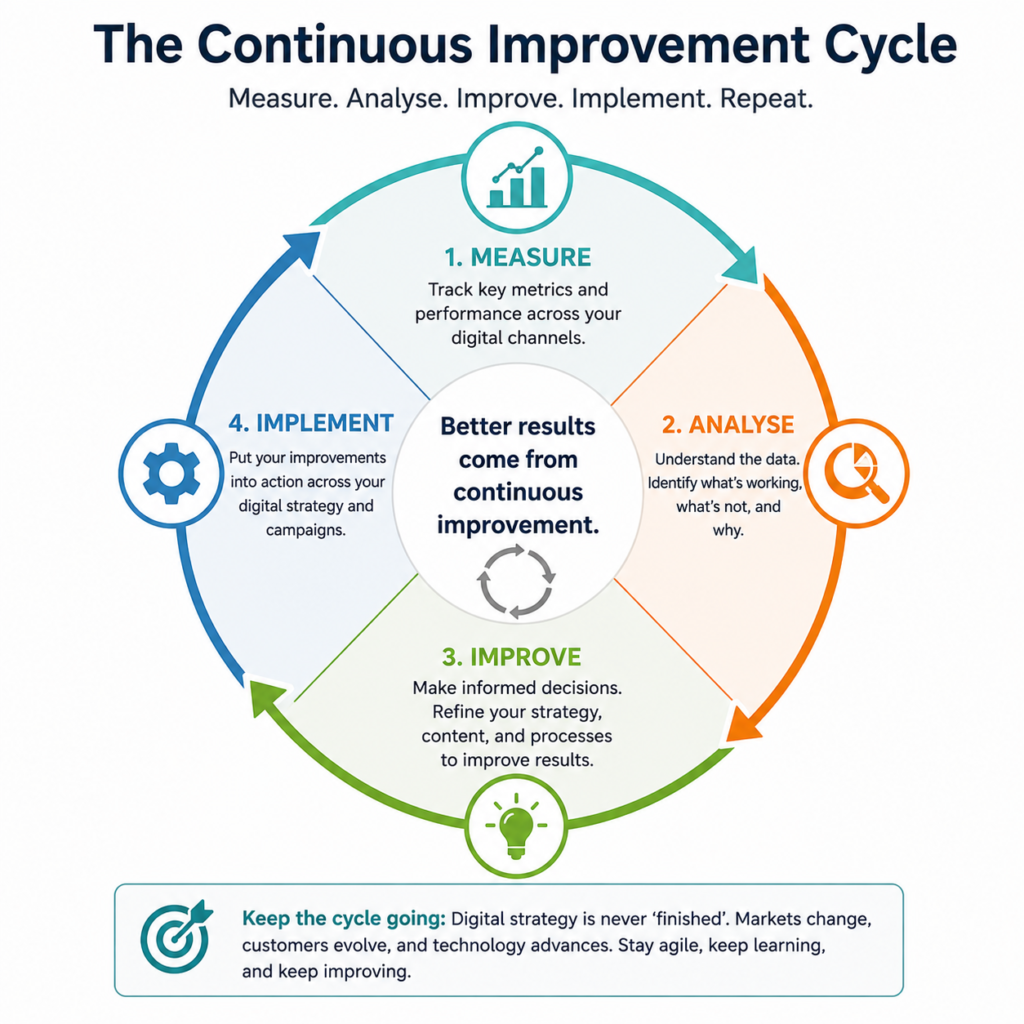
As you can see from the following infographic, the journey is not a straight line but a continuous cycle of research, implementation, measurement and improvement. As your business grows, your customers change and new technologies emerge, your digital strategy should evolve with them.

Research and Analysis
Every successful digital strategy begins with understanding your current position. Before deciding what changes to make, you need an accurate picture of your business, your customers and your competition.
Research and analysis provide the foundation on which every other decision is built. Investing time at this stage reduces the risk of making expensive mistakes later and ensures your strategy is based on evidence rather than assumptions.
Digital Analysis
Review your current digital assets and ask whether they are supporting your business effectively.
This might include:
- Your website
- Google Business Profile
- Search engine visibility
- Social media presence
- Email marketing
- Online reviews
- Analytics and reporting
The objective is to identify both strengths and opportunities for improvement.
Business Analysis
Your digital strategy should always support your wider business objectives.
Consider questions such as:
- What products or services are your priorities?
- Which services generate the greatest profit?
- Are you trying to attract new customers, retain existing customers or enter new markets?
- What does success look like over the next 12 months?
Without clear business objectives, digital marketing becomes a series of disconnected activities rather than a planned strategy.
Customer Analysis
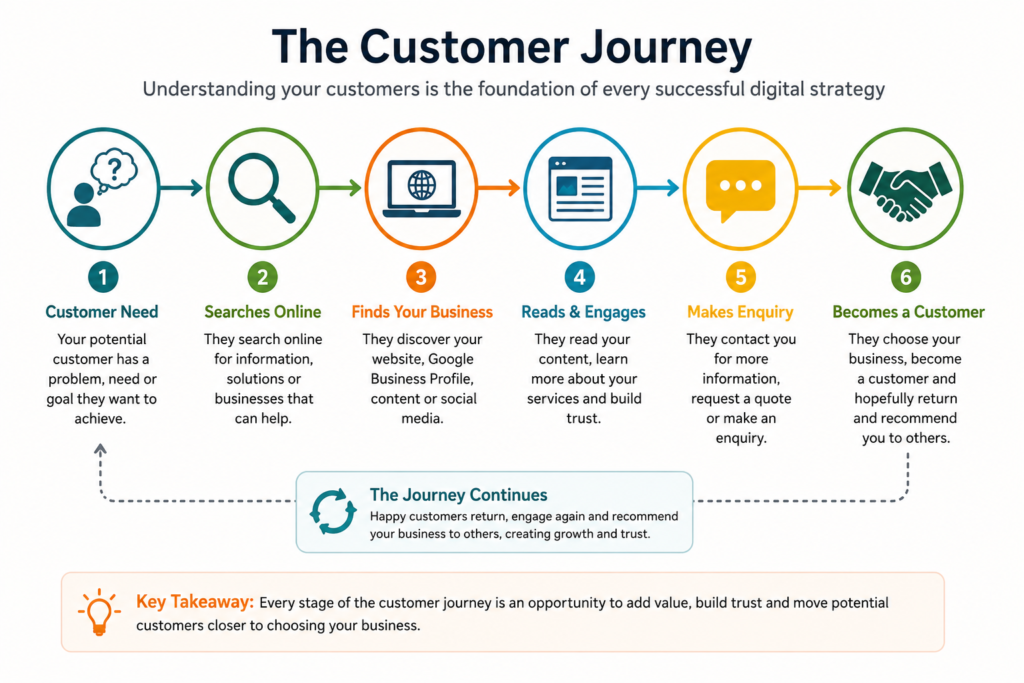
Understanding your customers is one of the most important parts of developing an effective digital strategy. Many businesses make the mistake of concentrating on what they want to sell rather than understanding what their customers are actually looking for.
Ask yourself:
- Who are your ideal customers?
- What problems are they trying to solve?
- What information are they searching for online?
- Which devices do they use?
- How do they prefer to communicate?
- What influences their buying decisions?
The answers to these questions will influence everything from the design of your website to the content you publish, the keywords you target and the digital channels you choose to use.
Understanding your audience allows you to create a better user experience and build stronger relationships with potential customers.
Competitor Analysis
Every business has competitors, whether they operate locally, nationally or internationally. Analysing their online presence can provide valuable insights and help you identify opportunities to differentiate your own business.
Look at:
- Their website
- Search engine rankings
- Google Business Profile
- Online reviews
- Social media activity
- Content they publish
- Services they promote
The purpose is not to copy your competitors, but to understand what they are doing well, where they may be falling short, and how your business can offer something better or different.
Competitor Analysis
Every business has competitors, whether they operate locally, nationally or internationally. Analysing their online presence can provide valuable insights and help you identify opportunities to differentiate your own business.
Look at:
- Their website
- Search engine rankings
- Google Business Profile
- Online reviews
- Social media activity
- Content they publish
- Services they promote
The purpose is not to copy your competitors, but to understand what they are doing well, where they may be falling short, and how your business can offer something better or different.
Market Analysis
The final stage of the research process is understanding the wider market in which your business operates.
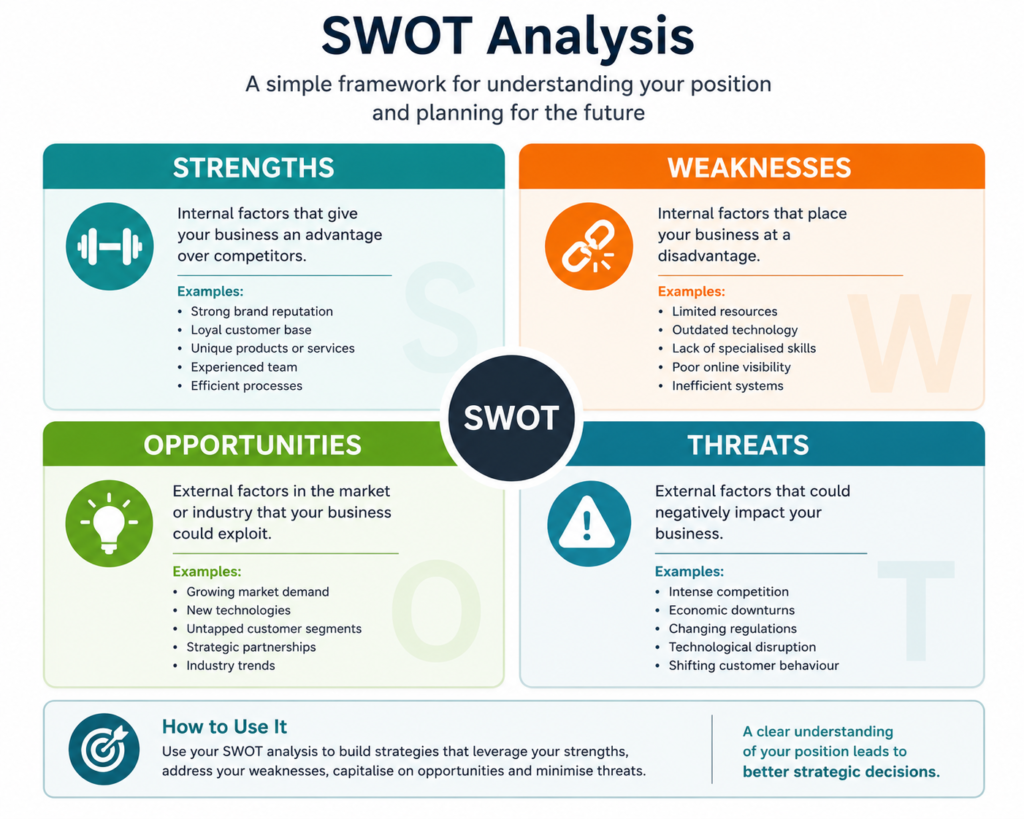
A useful way of doing this is by carrying out a SWOT Analysis, identifying your:
- Strengths
- Weaknesses
- Opportunities
- Threats
Strengths and weaknesses are usually internal factors that you can influence, while opportunities and threats are external factors that may affect your business.
For example, advances in Artificial Intelligence may present new opportunities to improve customer service or content creation, while increasing online competition may represent a threat if your business fails to adapt.
A good digital strategy recognises both the opportunities available today and the challenges that may arise tomorrow.
Setting Your Goals
Now we have completed the research and analysis stage of our Digital Strategy, we can begin setting clear and measurable objectives.
A goal without a plan is just a wish!
Antoine de Saint-Exupery
Your goals should support your overall business objectives and be realistic, measurable and achievable. Rather than simply aiming to “get more visitors” to your website, define goals that contribute directly to business success.
Examples might include:
- Increasing enquiries from your website.
- Improving your visibility in local search results.
- Growing organic search traffic.
- Generating more qualified leads.
- Increasing customer engagement.
- Improving conversion rates.
- Strengthening your online reputation through customer reviews.
Once your objectives have been defined, you can begin developing the practical activities needed to achieve them.
Implementation
Once you have completed your research and defined your objectives, it is time to put your Digital Strategy into action. This is the stage where planning becomes implementation.
Many businesses make the mistake of jumping straight to this stage without carrying out the research first. They build a new website, start advertising on social media or invest in Search Engine Optimisation (SEO) without a clear understanding of what they are trying to achieve. A successful Digital Strategy ensures that every activity supports your overall business objectives.
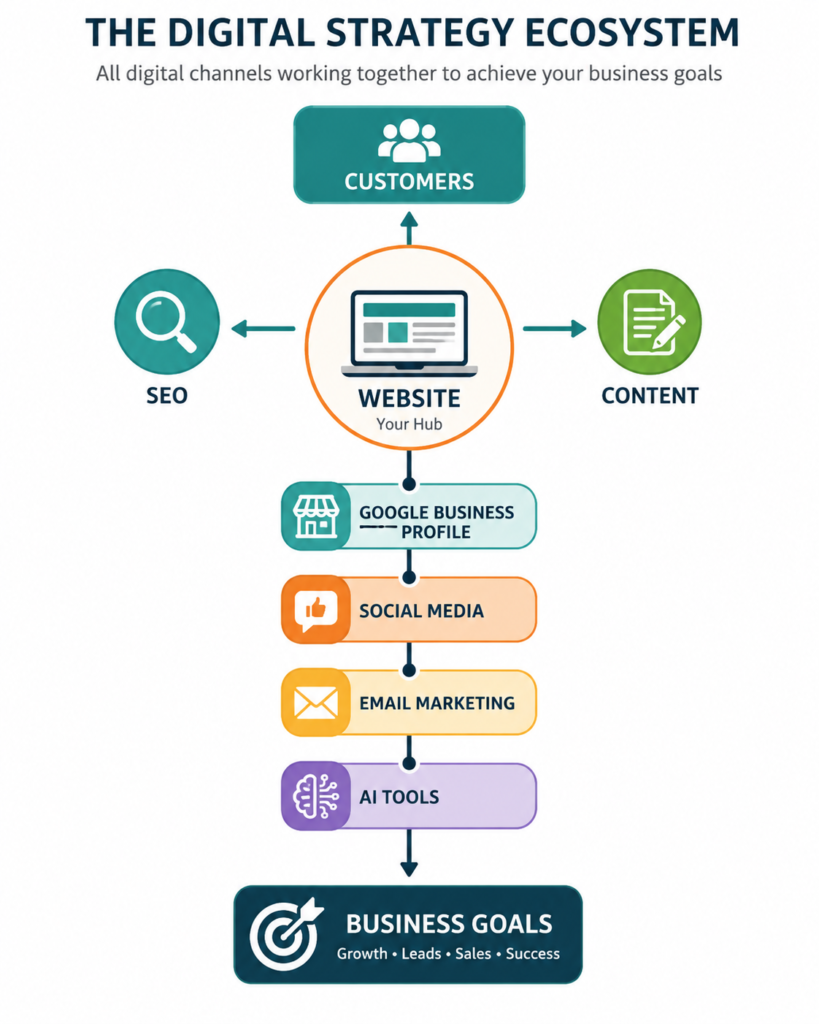
Implementation may include:
- Developing or improving your website.
- Optimising your website for search engines (SEO).
- Creating or improving your Google Business Profile.
- Producing valuable and informative content.
- Developing a social media strategy.
- Email marketing.
- Online advertising.
- Using Artificial Intelligence (AI) to improve productivity and customer engagement.
Not every business will use every digital channel, and they certainly don’t all need to be implemented at once. The key is to prioritise the activities that will have the greatest impact on your business and introduce them as part of a planned programme rather than a series of disconnected projects.
A Digital Strategy should always be practical, realistic and aligned with the resources available to your business.
Measurement and Optimisation
Implementing your Digital Strategy is not the end of the journey. In many ways, it is just the beginning.
One of the greatest advantages of digital technology is that almost everything can be measured. Unlike traditional forms of marketing, digital channels provide valuable information about how visitors interact with your website, how they found your business and whether your online activity is achieving the results you expected.
Useful measures might include:
- Website traffic.
- Search engine rankings.
- Google Business Profile performance.
- Online enquiries.
- Telephone calls.
- Email enquiries.
- Conversion rates.
- Customer reviews.
- Sales and revenue generated online.
Regularly reviewing this information allows you to identify what is working well and where improvements can be made.
Markets change, competitors evolve, search engines update their algorithms, and new technologies emerge. A Digital Strategy should therefore be reviewed regularly and refined as your business develops. The most successful businesses are those that continually measure, learn and improve.
Digital Strategy in the Age of AI
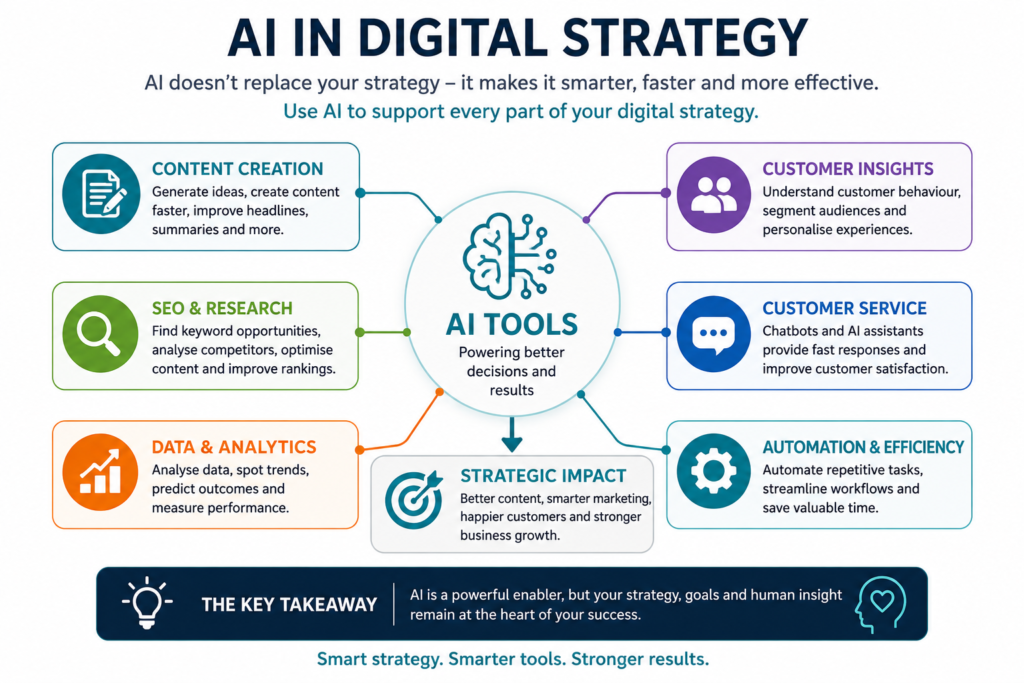
Artificial Intelligence is changing the way businesses operate online, but it has not changed the need for a clear Digital Strategy. In fact, it has made strategic planning even more important.
AI can help businesses create content, analyse data, improve customer service and automate routine tasks. However, AI is a tool rather than a strategy. Without clear business objectives and a structured plan, AI simply allows businesses to produce more content or automate more processes without necessarily achieving better results.
Search is also changing. Increasingly, potential customers are finding answers through AI-powered search experiences as well as traditional search engines. Businesses therefore need to think not only about Search Engine Optimisation (SEO), but also about creating clear, trustworthy and authoritative content that is useful to both people and AI-powered search systems.
A modern Digital Strategy should embrace these new technologies while remaining focused on what has always mattered most — understanding your customers and helping them solve their problems.
Common Digital Strategy Mistakes
Many businesses invest considerable time and money in digital marketing without first developing a strategy. Some of the most common mistakes include:
- Building a website without defining clear business objectives.
- Concentrating on technology instead of customer needs.
- Trying to use every social media platform rather than focusing on those that matter most.
- Ignoring local search and Google Business Profile.
- Measuring website visitors rather than business outcomes.
- Failing to review and update their strategy as the business grows.
Avoiding these common mistakes can save both time and money while improving the effectiveness of your digital activities.
Digital Strategy Is a Continuous Process
A Digital Strategy should never be viewed as a document that is written once and then forgotten.
Your business will evolve. Customer expectations will change. New competitors will enter the market. Search engines will continue to develop, and new technologies such as Artificial Intelligence will create both opportunities and challenges.
For these reasons, Digital Strategy should be viewed as a continuous cycle of research, planning, implementation, measurement and improvement.
By reviewing your strategy regularly, you can ensure that your business continues to adapt, remains competitive and makes the best possible use of digital technology.
Prefer a Printable Version?
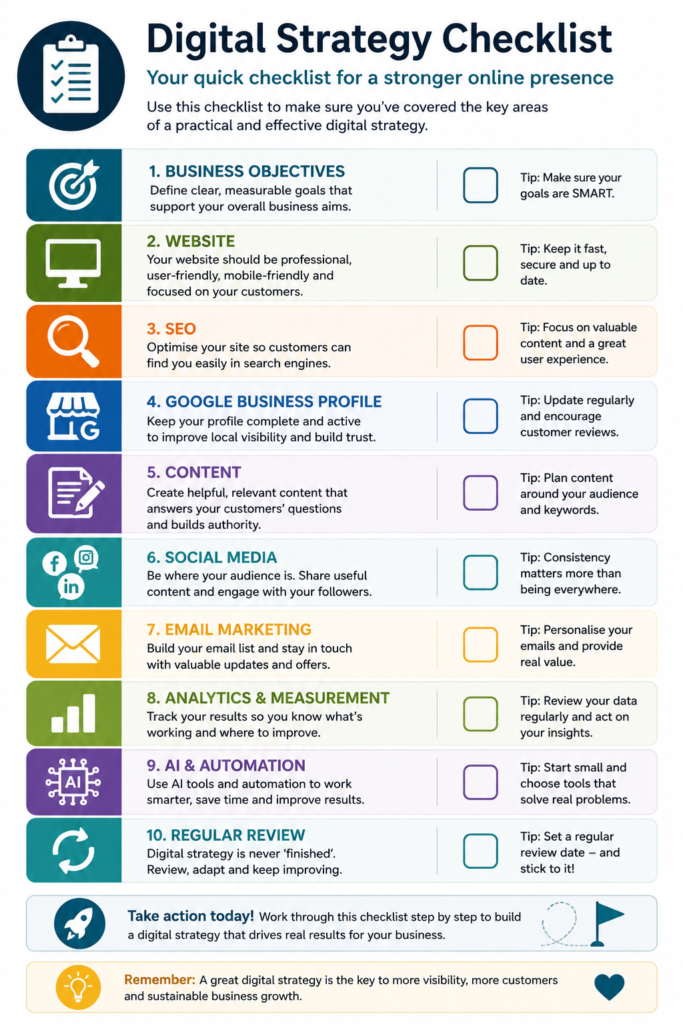
If you’d like to work through this guide offline, you can download our Digital Strategy Checklist (PDF) and use it to review your own business or discuss your digital strategy with colleagues and your team.
If you find this guide useful and would like access to future checklists, practical guides and downloadable resources, subscribe to our free Digital Strategy newsletter. We’ll let you know whenever new content is published, helping you stay up to date with the latest digital strategy, websites, SEO, AI and online marketing advice for small businesses.
Conclusion
A successful Digital Strategy is much more than a marketing plan. It provides a clear framework for how your business uses digital technology to achieve its objectives and support long-term growth.
Whether your goal is to attract more customers, improve your online visibility, increase sales or strengthen your brand, success begins with understanding where your business is today and developing a practical plan for where you want it to go.
Digital technology will continue to evolve, but the principles of good strategy remain the same. Research first. Plan carefully. Implement with purpose. Measure the results. Learn from the data and continue to improve.
By following this approach, your Digital Strategy becomes a valuable business tool rather than simply another marketing document.
Further Reading
If you found this guide useful, you may also be interested in:
- The Complete Small Business Guide to Google Business Profile
- What Is Search Engine Optimisation (SEO)?
- Content Marketing for Small Businesses
- How AI Is Changing Digital Marketing
- Local Search: Helping Customers Find Your Business
How Digital Direction Can Help
Developing an effective Digital Strategy takes time, experience and an objective view of your business. Whether you’re starting from scratch or reviewing an existing strategy, Digital Direction provides practical, independent advice to help small businesses improve their online visibility and achieve measurable results.
From Digital Strategy and Website Consultancy to Search Engine Optimisation (SEO), Google Business Profile management and content planning, we can help you develop a strategy that works for your business today and continues to support your growth in the future.
Learn more about our Digital Consultancy services at Digital Direction.